

Precision machining of PCBN cutting tools using ultra-fine grained grinding wheels
Jul 01, 2025
Leave a message
PCBN is widely used in precision machining of high hardness materials (hardness greater than 50HRC) due to its high hardness, high wear resistance, high chemical inertness, and thermal stability.
The precision machining of PCBN cutting tools often uses diamond polishing paste with a particle size of 3-5 μ m. However, due to the harsh conditions of polishing, the handling of a large amount of harmful polishing slurry, and the price of polishing paste, it is not conducive to the large-scale processing of PCBN tools. Research has found that consolidating ultrafine grained diamond grinding wheels is beneficial for reducing surface roughness, which in turn can lower the manufacturing cost of PCBN cutting tools.
Compared with resin bonding agents, ceramic bonding agent diamond grinding wheels have the characteristics of high strength, low heat generation and blockage, and high grinding efficiency, and are commonly used for grinding PCBN tools. Ultra fine grained diamond is prone to agglomeration due to the effects of electrostatic attraction and surface tension, which affects the lifespan of the grinding tool and the surface quality of the workpiece. It is found that the dispersion of M2.5/5 diamond in ceramic bond can be improved by combining sol gel technology with surfactant. Therefore, based on M2.5/5 diamond, the grinding performance difference of PCBN tools with vitrified bond diamond grinding wheels prepared by sol gel method and melt quenching method was compared.
Comparison of Precision Grinding of PCBN Cutting Tools
The lower surface roughness of the tool can reduce the friction between chips and the tool, enhance the tool's lifespan, and improve the surface smoothness of the workpiece. For the recently emerging PCBN coated cutting tools, the bonding strength between the coating and the tool is particularly important for the effectiveness of the coating. Reducing the surface roughness of the cutting tool can improve the bonding strength between the tool and the coating.
Figure 1 shows the polishing effect of ceramic bond grinding wheels prepared by different methods on PCBN cutting tools. Figure 1 (a) shows the surface morphology and surface roughness of the tool before polishing, indicating the presence of numerous pits formed by CBN detachment during the forming grinding process on the tool surface before polishing. The surface roughness of the cutting tool is 0.514 μ m, and the difference between the highest and lowest points is 8.647 μ m. Figure 1 (b) shows the SEM image and surface roughness of the PCBN tool after grinding with the diamond wheel prepared by the sol gel method. It can be seen from the figure that the CBN inside the tool is mainly single particle shedding, and there is no mass shedding phenomenon. Its surface roughness is 0.074 μ m, and the difference between the highest and lowest points is 2.450 μ m. Figure 1 (c) indicates that there is a significant amount of CBN detachment inside the tool. Its surface roughness is 0.118 μ m, and the difference between the highest and lowest points is 11.087 μ m.
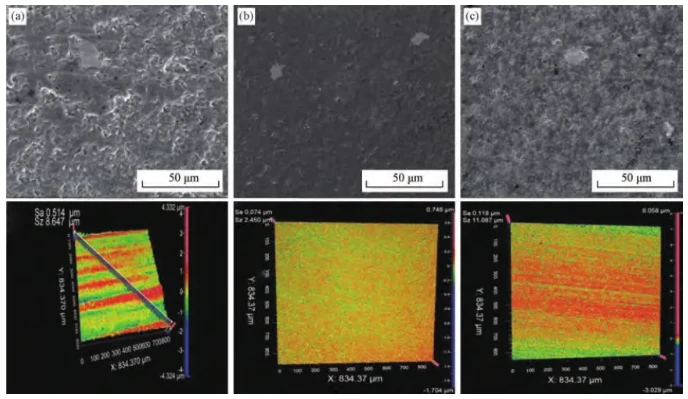
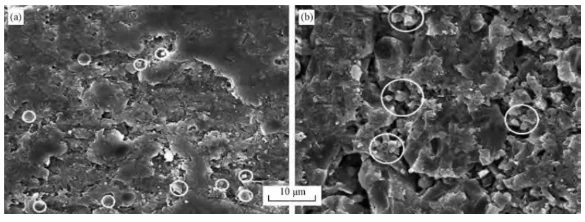
Figure 2 shows SEM images of diamond grinding wheels prepared with ceramic binders using different processes after grinding. According to Figure 2 (a), M2.5/5 diamonds are uniformly distributed in the ceramic binder, as indicated by the circled areas in the figure. The dense structure indicates that the binder has excellent grip on diamond, and the wear mode of the grinding wheel is frictional wear and adhesive wear. Figure 2 (b) shows that M2.5/5 diamond is unevenly distributed in the ceramic binder, with agglomeration phenomenon, as indicated by the circled area in the figure. The loose structure indicates poor grip of the binder on the diamond, and no obvious diamond wear is observed, indicating the problem of premature detachment of the diamond.
The grinding experiment shows that compared with the ceramic bond prepared by the sol gel method, the diamond in the ceramic bond prepared by the melt quenching water method is agglomerated, which reduces the bond strength of the bond and increases the surface roughness of the PCBN tool. The vitrified bond diamond grinding wheel prepared by the sol gel method can improve the surface machining quality rate of PCBN tools, which points out the direction for precision grinding PcBN tools with consolidated abrasives.
Send Inquiry