

Which Quality and Test Documents Matter When Buying Diamond Tools
Nov 20, 2026
Leave a message
Buyers sourcing diamond tools are usually handed a bundle of documents before the order is placed or before shipment. These papers differ in kind: some attest to a management system, some attest that a blade will not come apart at overspeed, some record results for a single batch of samples, and some exist only to clear customs. Knowing what each document does - and how to verify it - is the starting point for assessing a supplier.
The sections below set out purpose, verification points and coverage for each category.
1. Four categories that should not be conflated
| Category | What it establishes | Issued by | Product-specific? |
|---|---|---|---|
| Management system certification | Production and quality processes conform to ISO 9001 or ISO 45001 | Certification bodies | No |
| Product safety type testing | The model meets safety requirements under the test conditions defined by the standard | Test houses, oSa | Yes |
| Third-party test report | Results for the submitted samples, on the items tested | Laboratories, inspection companies | Yes, but limited to samples and scope |
| Conformity certificate for clearance | The product meets the destination country's technical regulations and listing requirements | National standards bodies and authorised agencies | Yes, document compliance |
Establishing which category is actually required before ordering reduces the risk of clearance delays or disputes at acceptance.
2. Product safety type documents: EN 13236 and oSa
EN 13236:2019, Safety requirements for superabrasive products, is published by CEN and applies to diamond and CBN blades, wheels, cup wheels and core drills. It addresses safety under high-speed operation; cutting speed and service life fall outside its remit.
The tests and checks it covers typically include:
- overspeed or burst testing at the test speed specified in the standard, verifying the body and the weld; this is a destructive test and the sample cannot be reused;
- side-load and bending tests simulating a pinched blade or run-out conditions;
- static balance and lateral run-out measurement;
- marking checks: maximum peripheral speed, rotation direction, bore, dimensions and batch identification;
- verification of body material, hardness, heat-treatment condition and weld continuity.
oSa (Organisation for the Safety of Abrasives) is the European abrasives safety organisation. Its member institutes test against EN 12413, EN 13236 or EN 13743 and, on that basis, issue a certificate of conformity carrying a registration number. Buyers can check that number in the oSa public register against the holder, product category and covered sizes.
One point worth noting: under the current EU regulatory framework, diamond tools are not a product category subject to mandatory CE marking. Where a supplier presents a "CE certificate", it is worth establishing whether the document is a third-party test report or the manufacturer's own declaration of conformity.
3. Laboratory reports: CNAS and CMA
CNAS accredits laboratories; CMA is the Chinese qualification requirement for testing and inspection bodies. Both concern the competence of the laboratory. The report itself is a record of results for the samples submitted.
When reviewing such a report, buyers generally check three things:
- whether it carries both the CNAS and ILAC-MRA marks - the latter indicates the laboratory operates within the international mutual recognition arrangement;
- whether the laboratory's accredited scope actually covers the test performed; holding CNAS accreditation does not mean that every test is within scope;
- whether the sample description matches the ordered model - designation, diameter, segment type, steel body thickness and bond specification.
Where the report was commissioned by the supplier, the buyer may prefer to nominate the laboratory in the purchase agreement, or require a copy accompanied by the laboratory's contact details for direct verification.
4. German institutes: MPA, IFA and TÜV
MPA (Materialprüfungsamt) are the official materials testing offices of the German federal states. In abrasives they carry out overspeed burst testing, body strength and safety assessment, issuing test reports or assessment opinions rather than a product mark.
IFA (Institut für Arbeitsschutz) is the research and testing institute of DGUV, the German statutory accident insurance body. Its work leans towards occupational safety and health - safe use of tools, dust and noise exposure, protective measures - and sits on a different plane from type testing.
TÜV organisations (Rheinland, SÜD and others) handle GS and CE-related assessment and system audits, and are encountered mainly in power tools and their accessories.
For European brand buyers, the usual combination is EN 13236 testing plus the oSa mark, with an MPA report where the customer requires it; where site occupational health requirements apply, an IFA or DGUV assessment is cited alongside.
5. Inspection bodies: SGS, BV, Intertek
These are inspection companies. They perform batch inspection and compliance testing, and do not issue product type certification. In diamond tool sourcing their work typically covers:
- pre-shipment inspection (PSI), commissioned by the buyer, checking appearance, dimensions, marking and packaging at the factory or before loading;
- batch consistency checks against the sealed sample;
- material and restricted-substance testing - RoHS, REACH, heavy metals;
- factory audits covering capacity, quality systems and social responsibility.
Such reports serve quality control at the shipping stage and are widely accepted for inspection and clearance in Southeast Asia, the Middle East, Africa and South America. As a basis for European market access they are normally supporting material only, not a substitute for EN 13236 type testing.
6. Conformity certificates for clearance: SASO, SONCAP, PVoC
SASO/SABER in Saudi Arabia, SONCAP in Nigeria and PVoC in Kenya are conformity assessment programmes operated by the destination country. They verify compliance with national technical regulations and listing requirements, and issue the certificate needed for clearance. These programmes are usually initiated by the importer or its authorised agent; responsibility and the document list are best settled before the contract is signed.
7. NAQS (Jinggong Boyan): a national testing centre for abrasives
For purchases made in China, one of the laboratories buyers most often encounter is NAQS - the National Abrasives Quality Inspection and Testing Centre, operated by Jinggong Boyan Testing Technology (Henan) Co., Ltd. and known in the trade as "Guomo Zhijian".
Background. The centre is affiliated with Zhengzhou Research Institute for Abrasives & Grinding Co., Ltd. (the Sanmo Institute) and also operates the National Abrasives Industry Metrology and Testing Centre. Its scope covers abrasives, refractories, ceramics, metals, packaging materials, food-contact materials and solid waste. It carries out commissioned testing, arbitration testing, import and export inspection and national supervisory sampling, alongside standards work, technical guidance and training.
Qualifications. According to the certificates published on its own website, the centre holds:
| Qualification | What it is | Why it matters to a buyer |
|---|---|---|
| CNAS accreditation | Laboratory accreditation by the China National Accreditation Service; Chinese and English certificates published | Puts reports within the ILAC-MRA mutual recognition arrangement, usable in cross-border disputes |
| CMA | Qualification of testing and inspection bodies in China | Gives reports legal standing domestically, for tenders and regulatory sampling |
| CAL | Authorisation review for national product quality testing bodies | The basis for carrying out national supervisory sampling |
| CML | Designation of the Fourth Mechanical Industry Metrology Station (Zhengzhou) | Covers traceability and metrology calibration work |
Where it helps. NAQS reports are useful in three situations: import and export inspection or arbitration when buyer and supplier disagree on results; re-testing after a batch dispute; and cases where a Chinese-language report bearing both CMA and CNAS marks is needed for a domestic joint venture, re-export or platform compliance.
Limits. The centre issues test reports within its accredited scope. It is not an EU type-certification body, and its reports do not by themselves constitute EN 13236 conformity. For European market access, the safety type evidence still has to come from a recognised EU body or through the oSa system.
Verification. Buyers can view the current CNAS certificates (Chinese and English) and the CMA certificate in the Qualifications section of the centre's website, cross-check the laboratory name, registration number and accredited scope on the CNAS website, and confirm a specific report by quoting its number to the centre.
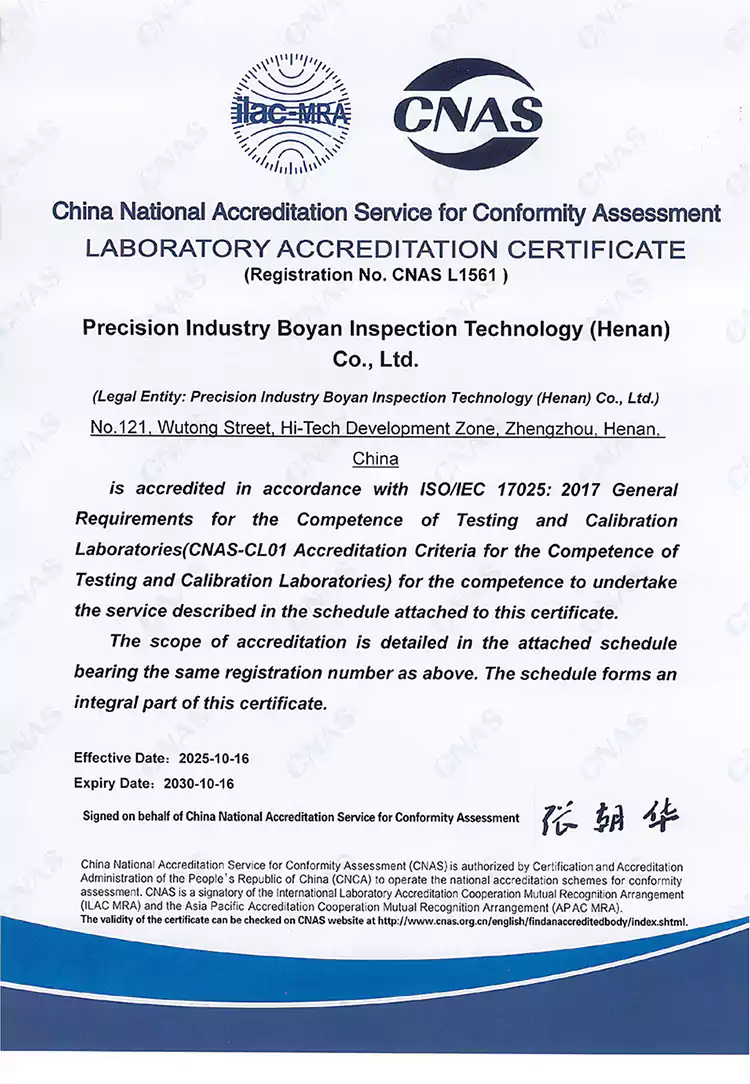
(CNAS Qualification Certificate:The above images are from the official website of Precision Industry Boyan (www.cagtic. cn). If there is any infringement, please contact our website to delete them)
8. Document sets by destination market
| Market | Documents normally requested | Notes |
|---|---|---|
| EU, UK, Nordics | EN 13236 test report, oSa certificate; MPA report where required | Buyers often require the oSa number to be verifiable |
| Germany, Austria, Switzerland | EN 13236, MPA report; DGUV/IFA assessment for site work | Brand owners and professional channels specify in more detail |
| US, Canada | ANSI B7.1 practice and the buyer's own specification; ISO 9001 documentation | Usually audited by the buyer or end user |
| Southeast and South Asia | SGS/BV/Intertek inspection reports, batch consistency records | Pre-shipment inspection is common |
| Middle East, Africa | SASO/SABER, SONCAP, PVoC and inspection reports | Clearance documents dominate |
| Domestic Chinese and re-export transactions | CMA + CNAS reports, e.g. from NAQS | Tenders and arbitration testing |
9. A buyer's verification checklist
Working through the following is a practical way to review a document set:
- certificate or report number, date of issue and validity period;
- name and status of the issuing body, and whether the third-party marks (CNAS, ILAC-MRA, oSa) are present;
- whether the model, size and steel body thickness listed match the order;
- the edition of the standard cited, and whether it is the current version;
- whether the covered range includes every size on the order, or whether sizes outside the model family were tested separately;
- whether the report is signed and carries the laboratory's contact details for direct verification;
- whether sample quantity and sampling method for destructive testing were agreed in the contract.
10. Document problems that recur
Among the situations encountered in sourcing:
- the model on the report differs from the model shipped, or coverage extends only to part of the diameter range;
- the laboratory's accredited scope does not include the test performed, yet the report still carries the CNAS mark;
- the standard cited has already been superseded;
- a supplier's own declaration stands in for third-party testing, in wording that is hard to pin down;
- a certificate remains in circulation after a change of bond, steel body supplier or process has invalidated it.
Most of these can be settled by checking the number and standard edition with the issuing body.
11. What to write into the purchase agreement
To limit later disagreement, buyers commonly specify:
- the category of document required, the standard number and the test items;
- sampling ratio, source of test samples and arrangements for retained samples;
- deadlines for submitting documents - after order, before production completion, before loading;
- who bears testing costs, and how a failed result is handled;
- the obligation to re-test when bond, steel body supplier or process changes.
12. Questions buyers ask
Q: What certificates does huicetools provide for its diamond tools?
A: huicetools can supply the following categories of documentation according to the order and the destination market. Whether a given model already has a report on file should be confirmed at the quotation stage.
The first category is product safety test reports. For blades, wheels and core drills sold into the EU, third-party test reports against EN 13236 can be provided; certain models hold oSa certificates of conformity, and the numbers can be checked in the oSa register. Such reports cover a model family - products of identical construction, bond and steel body, differing only in diameter or segment count. Sizes outside that family require separate testing.
The second category is laboratory test reports. Through NAQS (Jinggong Boyan / the National Abrasives Quality Inspection and Testing Centre) and other laboratories holding CMA and CNAS accreditation, reports can be issued for hardness, dimensions, static balance and run-out, weld quality and overspeed burst testing. These are usable for clearance, arbitration testing, or as third-party evidence in a quality dispute.
The third category is system and compliance documentation: a valid ISO 9001 certificate, mill certificates for raw materials, RoHS/REACH declarations or test reports, and dimensional and visual inspection records taken before packing.
The fourth category is inspection at the shipping stage. Where the buyer appoints SGS, BV or Intertek for pre-shipment inspection, we provide samples, production records and access to the site; the inspection standard, sampling ratio and acceptance criteria are best written into the agreement at order stage.
On testing costs and the scope of documentation. Testing and submission costs are normally borne by the party requesting them. Where a buyer specifies report requirements at quotation or order stage, we assist with arranging the testing, supplying samples and production records, and working with the laboratory through the test. The test fee, submission fee, sample consumption and return freight are borne by the buyer; the laboratory's quotation can be confirmed before submission, and we can relay it and follow progress.
As for scope: production and inspection are organised against the technical specification and inspection items agreed in the contract or order, and that constitutes the default delivery content. Reports not listed in the contract do not form part of the default document set. Where a buyer needs something additional, either before or after delivery, the request can be raised at any time; we will respond on whether a report already exists for that model, whether re-testing is needed and the likely lead time, and the two sides can then decide whether to proceed. The purpose of this arrangement is to avoid differing understandings of the document set at the delivery stage, and to let buyers select the items their own market access requirements call for.
Boundaries worth stating: the documents above relate to specific models and specific batches, and do not constitute a blanket undertaking across the product line; samples used in destructive testing cannot be returned; and where bond, steel body supplier or process changes, the corresponding report has to be reissued. If the destination market imposes additional mandatory requirements - Saudi SASO/SABER or Nigerian SONCAP, for example - these should be raised at quotation stage so that documents and lead times can be planned.
Closing
Test and certification documents for diamond tools fall into four functional layers: management systems, product safety, batch testing and clearance compliance. None substitutes for another. Buyers setting sourcing requirements generally determine the document set from the destination market's access rules and their own quality clauses, and write the verification method into the agreement at the same time.
About huicetools: a professional manufacturer of diamond tools, founded in 2006. With years of hands-on experience, we sell factory-direct at highly competitive prices. Our product line covers Diamond Segment, diamond saw blades, Diamond Grinding Shoes, Diamond Ring Saw Blade, Diamond Wall Saw Blade, Diamond Wire Saw, Diamond Grinding & Polishing Pad, Diamond Grinding & Polishing Disc, Diamond grinding blocks, diamond drill bits and a full range of diamond tools for construction & Stone applications.
Disclaimer: This article is compiled from publicly available standards, common industry practice and publicly available reports on the Chinese Internet, and is provided for industry reference only. Information concerning EN 13236, EN 12413, EN 13743, oSa, MPA, IFA/DGUV, TÜV, NAQS, SASO, SONCAP, PVoC and ANSI B7.1 is subject to the official texts published by those bodies; the accepted scope, validity of qualifications, test items, lead times and fees of any institution vary with product category and market requirements, and the current certificates published on an institution's website and a formal technical agreement prevail. This article does not constitute legal, certification or procurement advice. For republication or citation, please contact huicetools and credit the original source.
Link resources
- Precision Industry Boyan(NAQS) https://www.cagtic.cn/
- China National Accreditation Service for Conformity Assessment(CNAS)https://www.cnas.org.cn/
- Zhengzhou Research Institute for Abrasives & Grinding Co., Ltd.(ZZSM) www.zzsm.com
- Materialprüfanstalt Hannover(MPA Hannover)https://www.mpa-hannover.de
Send Inquiry