

Why are diamond micro-drills so hard and durable?
Sep 03, 2026
Leave a message
Why are diamond micro-drills so hard and durable?
There is a Chinese saying: "Don't take on the job of drilling porcelain unless you have a diamond drill bit." This adage holds true in the field of precision manufacturing. When dealing with hard, brittle materials like silicon wafers, ceramics, and glass, ordinary drill bits often wear out or chip after drilling only a few holes; in contrast, the diamond micro-drill can perform thousands of machining operations reliably.
Hailed as the ultimate "diamond drill," this micro-tool-often measuring just a fraction of a millimeter in diameter-is capable of drilling precise holes into the hardest materials. What makes it so exceptionally hard and durable? The answer lies in the atomic structure of diamond itself and in the ingenuity of modern coating technologies.
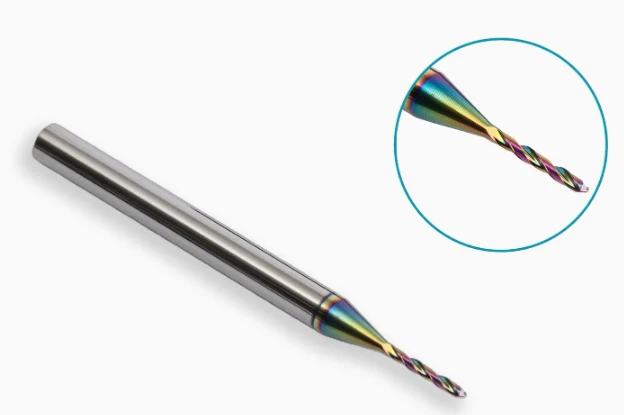
(Coated diamond micro drill bit)
I. Diamond: Nature's Hardness Champion
To understand the durability of diamond micro-drills, one must first understand diamond itself.
Diamond is the hardest substance in nature, boasting a Mohs hardness of 10-the highest possible rating-far surpassing common hard materials like quartz (level 7) and corundum (level 9). This extreme hardness is no accident; it is determined by the material's unique microscopic crystal structure.
Within a diamond crystal, each carbon atom forms sp³ hybridized covalent bonds with four neighboring carbon atoms, creating a tetrahedral structure. These covalent bonds are short, strong, and possess extremely high bond energy; extending uniformly in three dimensions, they form a tight, robust, and rigid 3D network. When external force attempts to scratch or indent the diamond, a vast number of these strong bonds must be broken simultaneously-an event that is virtually impossible under normal conditions.
It is precisely this structure-"locked tight at the atomic level"-that gives diamond its inherent, exceptional hardness and wear resistance. Micro-drills made from diamond stand at the pinnacle of the hardness pyramid by virtue of their fundamental material properties.
II. Two "Diamond" Paths for Micro-Drills
Diamond micro-drills do not come in just a single form. Based on manufacturing methods, they fall into two main categories:
1. Solid Sintered Type (PCD Micro-drills)
Diamond micropowder is sintered under high temperature and high pressure to form a Polycrystalline Diamond (PCD) tip, which is then brazed onto a drill shank. These micro-drills feature high diamond content and exceptional wear resistance, making them suitable for high-volume, high-precision machining of hard, brittle materials; however, they come at a relatively high cost.
2. Coated Type (Diamond-Coated Micro-drills)
A nano-diamond thin film is applied to the surface of a cemented carbide (typically tungsten-cobalt) drill substrate using processes such as Chemical Vapor Deposition (CVD). This approach combines the toughness of the substrate with the extreme hardness of the surface layer, making it one of the most widely used solutions today.
The brilliance of coating technology lies in the fact that the entire drill does not need to be made of diamond; by applying the diamond layer only to the critical "cutting edge," one can achieve cutting performance comparable to solid diamond while significantly reducing costs.
III. The Data: How Much of an Improvement Does a Coating Make?
The effectiveness of nano-diamond coatings can be measured by a set of clear figures:
- Applying a nano-diamond coating to the drill surface can extend its lifespan by more than tenfold.
- Under specific machining conditions, a diamond-coated drill can achieve a service life of up to 100,000 holes.
- This lifespan is more than 60 times that of a standard drill.
Why does such a thin coating make such a huge difference?
The reason is that during the drilling process, drill failure almost always begins with wear on the cutting edge; once the edge becomes dull, cutting forces rise sharply, leading to edge chipping or drill breakage. The diamond coating transforms the most wear-prone part of the edge into a surface of "peak hardness," delaying the wear process at the source and thereby significantly extending the overall service life of the drill.
What does a capacity of 100,000 holes actually mean? If a machine drills 30 holes per minute, a single diamond-coated micro-drill can operate continuously for over 55 hours without replacement, whereas a standard drill might require changing in less than an hour.
IV. What kind of work do "diamond drills" handle?
Diamond micro-drills are hailed as "diamond drills" precisely because they are designed to tackle hard, brittle materials that are difficult to process with standard cutting tools. Key materials processed include:
| Material Category | Typical Examples |
| Semiconductor materials | Monocrystalline silicon, polycrystalline silicon, silicon carbide, etc. |
| Ceramics and glass | Alumina ceramics, zirconia ceramics, quartz glass, etc. |
| Other hard materials | Titanium alloys, graphite, PCB circuit boards, etc. |
These materials share a common characteristic: high hardness and high brittleness. When processed with standard high-speed steel or cemented carbide drill bits, tools wear out rapidly, and the material edges are prone to chipping (known as "edge breakout"). Thanks to their extreme hardness and sharp cutting edges, diamond micro-drills can perform machining with lower cutting forces; this ensures high-quality hole walls while significantly reducing edge chipping defects.
In the semiconductor industry, for instance, machining micro-holes in silicon wafers demands exceptional precision and consistency, making diamond micro-drills indispensable core tools in this field.
V. Beyond the hardness: Limitations and the future of diamond micro-drills
Despite their outstanding performance, diamond micro-drills are not "universal" tools and have specific operational limitations:
- Vulnerability to high-temperature oxidation: Diamond begins to oxidize and lose mass in air at temperatures above approximately 700°C; therefore, they are unsuitable for prolonged dry cutting or operations that generate extreme cutting heat.
- Unsuitable for machining iron-group metals: At high temperatures, carbon atoms in the diamond diffuse into materials like iron and nickel, causing rapid tool wear (known as "chemical wear"). Consequently, cubic boron nitride (CBN) tools are typically chosen over diamond for machining steel.
- Coating adhesion is critical: The bond strength between the diamond coating and the cemented carbide substrate directly determines tool life, and coating delamination is a common mode of failure. Looking to the future, the technological evolution of diamond micro-drills focuses on areas such as nanocomposite coatings, surface texturing, and ultra-precise cutting-edge preparation. The goal is to further enhance toughness, heat dissipation, and coating adhesion while maintaining extreme hardness-enabling these "diamond drills" to tackle increasingly demanding tasks.

From the tetrahedral structure of carbon atoms to nanoscale diamond coatings and an astonishing service life of 100,000 holes-the exceptional hardness and durability of diamond micro-drills are the product of the convergence of materials science and precision manufacturing. The next time you see those hair-thin micro-holes on a chip, consider this: behind every single hole, a "diamond drill" has been quietly and steadfastly at work.
Send Inquiry