

Why Do Self-Leveling Flooring Workers Wear Spike Shoes
Oct 22, 2026
Leave a message
Anyone who has watched a self-leveling or epoxy flooring job has seen the scene: a worker steps straight into the wet, flowing compound wearing a pair of shoes studded with conical spikes. This is not a gimmick - it is a standard piece of flooring equipment known in the trade as spike shoes (or spiked shoe covers). Why are they essential, and how do you pick the right pair?
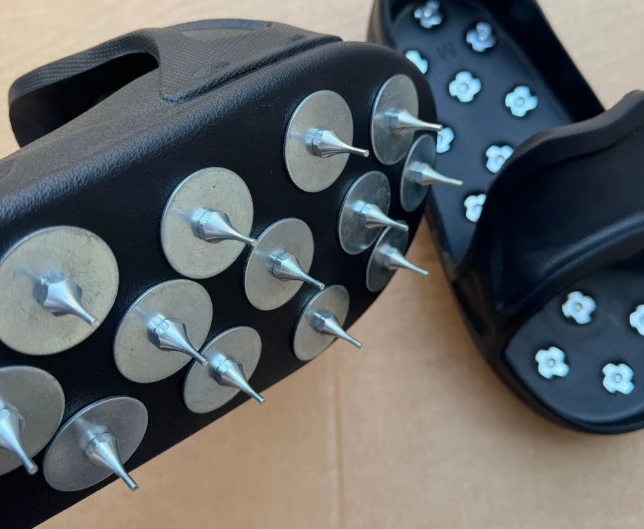
1. Why spike shoes: release air and help level
Self-leveling compound traps large amounts of air during mixing, pumping and pouring. If those bubbles stay trapped in the cured floor, they become pinholes, pitting or blisters that ruin the flat, glossy finish.
When a worker steps into the wet material wearing spike shoes, the bottom spikes do two jobs:
- Pop bubbles and release air - every step punches thousands of tiny holes through the wet layer, allowing entrained air to escape to the surface. Because the compound is still liquid, it flows back and self-heals those holes immediately;
- Assist spreading and leveling - the worker can feel the thickness underfoot and push the compound toward edges and corners.
Ordinary work shoes have flat soles. Stepping into wet compound with them only leaves deep footprints, traps air instead of releasing it, and creates depressions that cannot be fixed once the material cures.
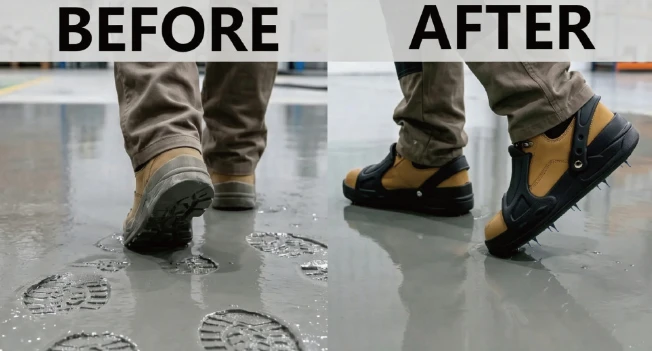
(After putting on the spiked shoes as shown in the picture, the construction leaves no traces. Comparison of the effect of wearing spiked shoes and the effect before and after wearing regular shoes.)
2. What spike shoes look like
A standard pair of self-leveling spike shoes has three parts:
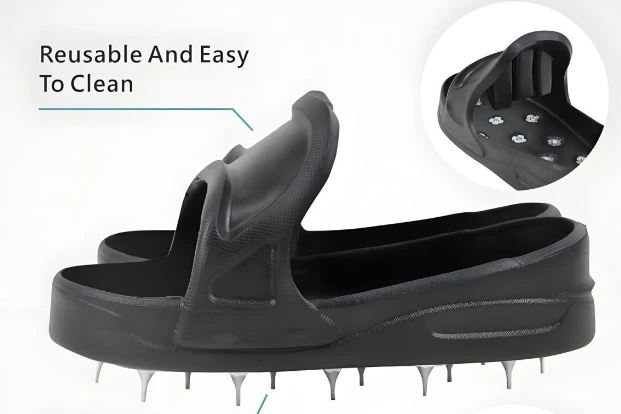
- Base plate: a rigid, foot-shaped plate roughly 25–30 cm long, usually injection-molded polypropylene (PP);
- Spikes: conical studs evenly distributed under the plate, commonly available in 15 mm, 20 mm and 30 mm lengths. Most are molded PP; metal-spike versions also exist;
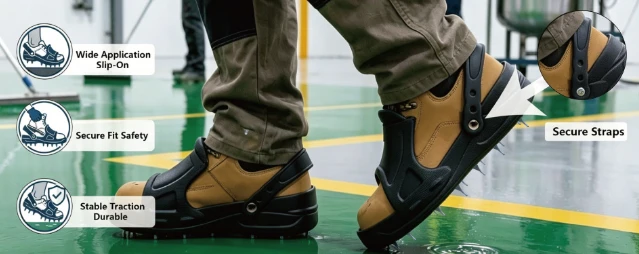
- Straps or clips: adjustable nylon straps or spring clips that fasten the spike shoe over the worker's own safety boots.
3. How to choose: four key parameters
Spike length - match it to the material thickness.
- 15 mm: thin epoxy self-leveling coats (2–3 mm) and thin cement-based toppings;
- 20 mm: the most versatile choice for standard 3–5 mm self-leveling;
- 30 mm: thick cement-based screeds (5–10 mm) or heavy epoxy mortars.
Spikes that are too short fail to pierce the air layer; spikes that are too long make the worker unsteady and risk ankle injury.
Spike density. A typical base plate carries between 15 and 30 spikes. Denser spikes release more air per step and are better for large areas; sparser plates are lighter and adequate for small patch repairs.
Base-plate material and comfort. One-piece PP plates are the mainstream choice - lightweight, chemical-resistant and reusable. Metal plates with metal spikes are more durable but heavy, causing fatigue over long shifts. Disposable plastic spike shoes exist but are single-use only. Look for a plate that follows the arch and straps that do not slip - the worker spends hours standing in wet compound, and foot fatigue directly affects finish quality.
Attachment system. Nylon straps fit a wider range of boot types and are the most common design; spring clips are faster to don but fit narrower last shapes. Straps are the safer, more versatile choice.
4. Work as a team: spike shoes plus spike roller
On large jobs, spike shoes are used together with a spike roller (also called a de-airing roller or air-release roller). The roller, pushed by hand, covers the open floor for bulk air release; the worker's spike shoes reach the edges, doorways, equipment foundations and other areas the roller cannot cover. Only together do they guarantee a bubble-free floor.
5. Care and field tips
- Rinse immediately after each job with clean water. Dried compound trapped between spikes blunts them and ruins air-release performance next time;
- Replace when spikes wear or break - de-airing efficiency is directly tied to sharp spikes;
- Always wear spike shoes over your own safety boots - never barefoot or in flip-flops;
- On epoxy self-leveling jobs, walk steadily: the tacky compound and the bottom of the plate both become coated with resin, and slips are a real hazard.
Closing
A pair of spike shoes costs only a few dozen dollars, yet it directly decides whether the finished self-leveling surface is free of pinholes, pitting and footprints. Pick the right spike length, keep the spikes sharp, and work them together with a spike roller - that is how crews get a flat, dense, bubble-free floor. For any flooring contractor, this is one of the highest-return items on the job trailer.
About huicetools: a professional manufacturer of diamond tools, founded in 2006. With years of hands-on experience, we sell factory-direct at highly competitive prices. The diamond floor grinding blocks(Diamond Grinding Block/Shoes) developed and produced by our company have strong grinding force, long service life, and high grinding efficiency. Used for the renovation and polishing of concrete flooring, epoxy flooring, self leveling, terrazzo and other flooring.

Disclaimer: This article is adapted and rewritten from publicly available reports on the Chinese Internet and general industry knowledge, provided for industry reference only. Spike-shoe specifications, selection advice and construction descriptions are for guidance only; always follow the material manufacturer's instructions and site conditions. We make no representation as to the completeness, accuracy or timeliness of this information, and this article does not constitute procurement or construction advice. For republication or citation, please contact huicetools and credit the original source.
Send Inquiry