

Superhard Material Export Controls Stay Suspended Until 10 January 2027
Nov 22, 2026
Leave a message
On 9 November, the Ministry of Commerce published Announcement No. 58 of 2026, issued jointly with the General Administration of Customs. With approval, the implementation of Announcements No. 55, 56, 57 and 58 of 2025 - issued jointly by the two bodies - together with Ministry of Commerce Announcements No. 61 and 62 of 2025, remains suspended from 11 November 2026 to 10 January 2027.
The previous suspension ran from 7 November 2025 to 10 November 2026 and expired on the day before publication. Without this announcement, export licensing for the superhard material items concerned would have resumed on 11 November. The extension adds 60 days to the transition period.
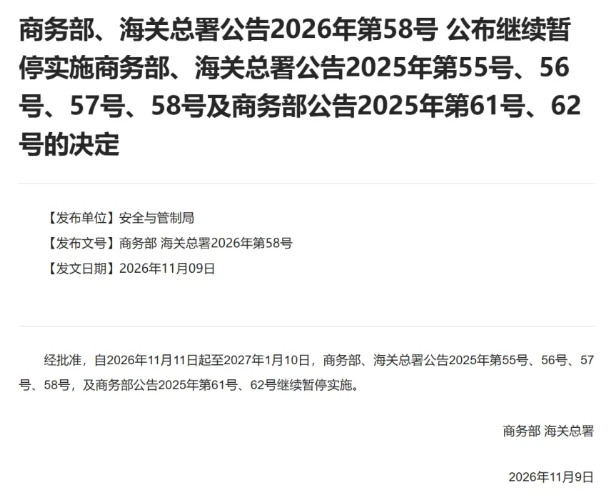
(Screenshot of relevant notices from the Ministry of Commerce From public networks)
1. Timeline
| Date | Event |
|---|---|
| 9 October 2025 | Announcement No. 55 of 2025 published, imposing export controls on superhard material items, originally due to take effect on 8 November 2025 |
| Late October 2025 | Consultations between Chinese and US trade teams in Kuala Lumpur produced a consensus: the US side suspended its 50% affiliates rule for one year, and the Chinese side suspended the export control measures announced on 9 October for one year |
| 7 November 2025 | Announcement No. 70 of 2025 issued, suspending the six announcements from that date to 10 November 2026 |
| 9 November 2026 | Announcement No. 58 of 2026 issued, extending the suspension to 10 January 2027 |
The extension is two months, against the one-year suspension agreed in November 2025. Public commentary has described the shorter window as a transitional arrangement ahead of further consultations; the position after it expires will be determined by subsequent official announcements.
2. What the measures cover
The suspended measures correspond to the following entries in the dual-use items export control list:
| Code | Item and parameters |
|---|---|
| 2C902.a | Synthetic diamond micropowder with an average particle size of 50 µm or less |
| 2C902.b | Synthetic diamond single crystal with an average particle size of 50–500 µm, excluding lab-grown diamond for decorative and jewellery use |
| 2C902.c | Synthetic diamond wire saw with a wire diameter of 45 µm or less, diamond average particle size of 8 µm or less, and breaking strength of 16 N or less |
| 2C902.d | Synthetic diamond grinding wheels of specified parameters |
| 2B005.b | Direct-current arc plasma jet chemical vapour deposition (DCPCVD) equipment |
| 2E902 | DCPCVD process technology |
In the supply chain, diamond micropowder and wire saws are consumables in photovoltaic wafer slicing and precision machining; DCPCVD equipment and process technology relate to functional diamond for semiconductor thermal management and optical windows.
For exporters, the operative detail is the mapping between codes and parameters. Entry 2C902.c, for instance, sets thresholds on wire diameter, grit size and breaking strength at the same time, while 2C902.b carves out lab-grown diamond for jewellery. Whether a product falls within the list should be established specification by specification, not by product category as a whole.
3. Suspension is not removal
One point is easily missed: suspension of implementation does not remove anything from the list. Entries 2C902, 2B005 and 2E902 remain in the dual-use items export control list. Whether licensing resumes for the items concerned after this extension expires depends on subsequent policy arrangements.
4. Two waves visible in the export data
Shifts in policy expectations left a fairly legible trace in trade statistics over the past year.
First wave: stockpiling, then digestion. In the first quarter of 2026, Chinese exports of synthetic diamond, single crystal and micropowder combined, came to 825 million carats, below the 1.089 billion carats recorded in the same period of 2025. Public analysis attributes the fall to overseas customers stockpiling after the October 2025 announcement, followed by slower purchasing once the measures were suspended, as earlier inventory was drawn down.
Second wave: orders locked in ahead of the deadline. Through the second half of 2026, as 10 November approached, expectations of a resumption of licensing built up and exports expanded again. Third-quarter 2026 figures:
- volume of 1.810 billion carats, up 80.54% year on year;
- value of RMB 492 million, up 81.34% year on year;
- September alone up more than 129% year on year by volume.
By destination, India accounted for 30.42%, Ireland 14.73% and the United States 11.07%, with the top seven markets taking 84.4% of the total. By province of origin, Henan led with 57.48%, followed by Jiangsu at 18.03% and Hunan at 4.84%.
Analysis published by China Superhard Materials Network suggests that with the extension in place, the incentive for concentrated stockpiling has weakened, the pull-forward effect is expected to fade, and export activity should return to a more normal rhythm.
5. Three routine steps for the 60-day window
Compliance practitioners quoted in public reporting set out three points for operations during the window.
Keep the compliance file current. Shipments made while the measures are suspended should still be supported by complete records: the basis for item classification, customer background checks and end-use verification. If licensing resumes, those records are the company's evidence of compliant operation.
Other obligations continue unchanged. Only the measures under the six announcements are suspended. The underlying obligations under the Export Control Law, the Regulations on Export Control of Dual-Use Items and the list itself are not reduced; military-related, nuclear-related and end-user/end-use management continue as before.
Plan around 10 January 2027 in advance. Absent a further extension, licensing would resume for the items concerned after that date. Companies are advised to review open orders and shipment schedules early and to set customs declaration dates so that cargo does not sit idle through a policy switch.
Closing
From publication in October 2025, suspension in November 2025, and a further two-month extension in November 2026, the sequence shows up directly in the trade figures: a first-quarter decline, a third-quarter surge, both keyed to policy dates. For exporters, the actionable part is not forecasting policy but aligning three things - the compliance file, the order book and the declaration date - to a timetable that is already published.
About huicetools: a professional manufacturer of diamond tools, founded in 2006. With years of hands-on experience, we sell factory-direct at highly competitive prices.
Disclaimer: This article is adapted and rewritten from announcements of the Ministry of Commerce and the General Administration of Customs, and from publicly available reports on the Chinese Internet, and is provided for industry reference only. Announcement numbers, effective and suspension dates, controlled item codes and parameters, and trade statistics cited herein come from official announcements and public reporting; the scope of application and the classification of any specific product should be determined against the text of the announcements, the list itself and the interpretation of the competent authorities. This article does not constitute legal, compliance or trade advice, and exporters should confirm with their customs broker or a qualified compliance provider before shipment. We make no representation as to completeness, accuracy or timeliness. For republication or citation, please contact huicetools and credit the original source.
Send Inquiry