

Precautions for grinding and polishing terrazzo
Dec 31, 2025
Leave a message
In recent years, a wide variety of natural stone, wood, artificial stone, and various plastic materials have been widely used in the design of building floorings. Among these, cast-in-place terrazzo flooring has proven through years of construction practice to offer several advantages, including high strength, a smooth and even surface, ease of maintenance and cleaning, ease of achieving aesthetic decorative effects, and low cost. It has been widely used in the flooring of public buildings such as school buildings. Based on our years of experience, we have summarized the precautions for terrazzo grinding and polishing.
Terrazzo flooring is divided into two types: ordinary terrazzo and colored terrazzo.
The color matching of colored terrazzo is determined by the design and construction party through on-site sample selection. The terrazzo construction method adopts on-site pouring and polishing.
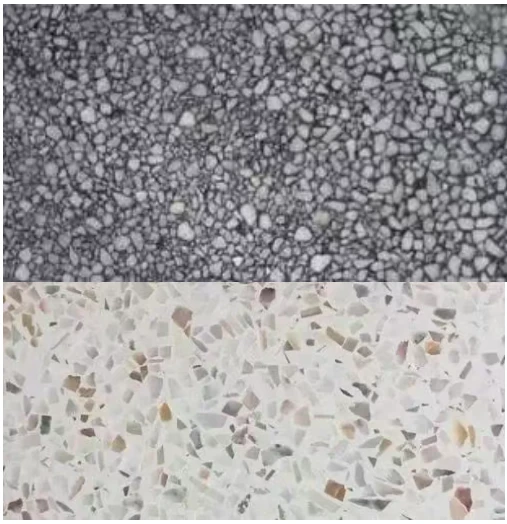
Terrazzo grinding surface
The timing of terrazzo grinding affects the strength of the cement mortar, which in turn is related to the ambient temperature. The mortar strength should be moderate during grinding; excessively high strength will lead to increased grinding time, while insufficient strength will cause aggregate particles to fall out during grinding. At normal temperatures, grinding can generally begin 2-3 days after the completion of cement aggregate mortar application.
During grinding, water should be continuously applied to the grinding disc to flush away the ground-off mortar. Due to insufficient compaction during cement aggregate mortar application, slight localized pores may appear in the finished terrazzo; these can be treated by applying additional mortar.
Terrazzo flooring should be ground three times and patched twice during the polishing process.
At normal temperatures, the first grinding should be performed 2-3 days after the completion of cement aggregate mortar application. The first grinding aims to roughly level the terrazzo surface, ensuring the pattern and shape of the terrazzo are clearly visible. Any defects should be patched promptly.
The second grinding should be performed 2-3 days after the first grinding. This grinding aims to eliminate grinding marks, followed by patching any remaining small defects.
The third grinding is performed 2-3 days later. This final grinding is crucial for the finished quality, requiring uniform aggregate exposure, a smooth surface, no pores, and excellent visual quality.
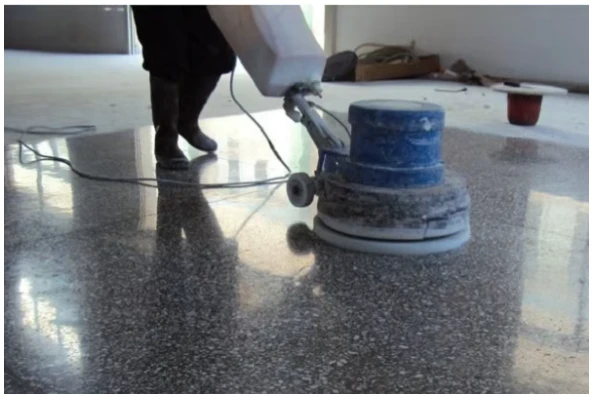
Terrazzo Polishing
Polishing is the final step in terrazzo construction and is crucial for achieving a good visual quality. Polishing involves both physical and chemical processes. Under the action of the polishing liquid, a chemical reaction occurs with the protruding parts of the surface, and the resulting products are pressed into the depressions. Through a series of physical and chemical actions, a glossy film is formed on the surface. After waxing and protection, the terrazzo floor exhibits a lasting shine. Waxing should be done only after the surface is completely dry. Before waxing, spray the surface with oxalic acid solution (generally 10% concentration), then polish it once, rinse it thoroughly with clean water, and apply wax and polish after the floor is dry.
Send Inquiry