

Why Add PCD to Floor Grinding Segments?
Oct 12, 2026
Leave a message
Why Add PCD to Floor Grinding Segments & Shoes?
A look at the coating-removal workhorse of concrete floor refurbishment
It Starts with an Age-Old Jobsite Problem
Anyone who has refurbished an old factory floor has run into the same headache: that thick layer of epoxy coating, carpet adhesive, polyurethane coating, or old waterproofing membrane. If you attack it with conventional metal-bond diamond grinding segments, the tool cuts fine at first - then gradually "loads up." The segment face gets caked with softened resin and glue, cutting performance falls off a cliff, and you're forced to stop the machine, swap segments, and lose valuable time.
The root cause lies in how the tool works. Conventional diamond segments remove material by abrasive grinding: the diamond grit rubs and plows across the surface, and that friction generates heat. Polymeric materials like epoxies and adhesives soften and turn gummy as soon as they heat up, smearing into the pores of the metal bond matrix until the segment is effectively blinded. In the trade, this is known as glazing or gumming up (also called loading).
PCD - polycrystalline diamond - exists to tackle these stubborn coatings with a completely different approach: stop grinding, start scraping.
What Is PCD, and Why Is It So Effective?
PCD is produced by sintering diamond micro-powder under high temperature and high pressure into a polycrystalline layer, bonded onto a tungsten carbide substrate to form a composite insert. Its character boils down to three words: hard, tough, and sharp.
- Extremely hard: Its wear resistance far exceeds that of single-crystal diamond and tungsten carbide, giving PCD segments a service life typically 3 to 5 times longer than conventional metal-bond segments.
- Remarkably tough: The polycrystalline structure, backed by the carbide substrate, delivers excellent impact resistance. When the tool hits aggregate, screws, wire, or other hard debris embedded in the concrete, the PCD edge resists chipping - a decisive advantage over conventional carbide scrapers.
- Razor-like edge: The solid PCD insert forms one continuous cutting edge that works like a machined scraper, with a positive cutting geometry.
The Core Principle: Shear Scraping Instead of Abrasive Grinding
This is the key to understanding PCD's value.
| Conventional Metal-Bond Diamond Segment | PCD Segment | |
|---|---|---|
| Removal mechanism | Abrasive grinding (grit rubbing / plowing) | Shear scraping and peeling |
| Heat generation | High frictional heat; softens thermoplastic materials | Low; shearing generates little heat |
| Behavior on epoxy / adhesive | Material softens, turns gummy, blinds the bond matrix | Material peels off in flakes and clears away as swarf |
| Clogging risk | High (glazing, loading) | Low; cutting ability is sustained |
| Depth per pass | Shallow; requires repeated passes | Removes 1–4 mm of epoxy / adhesive in a single pass |
| Intended stage | Concrete grinding, honing, and polishing | Heavy coating removal and surface prep |
Put simply: PCD doesn't grind the coating off - it scrapes it off in sheets, the way a scraper blade would. The material detaches as flaky swarf instead of smearing back onto the tool, and the low-heat shearing action never "melts" the resin or glue. This eliminates glazing and loading at the level of the underlying physics, not just the symptoms.
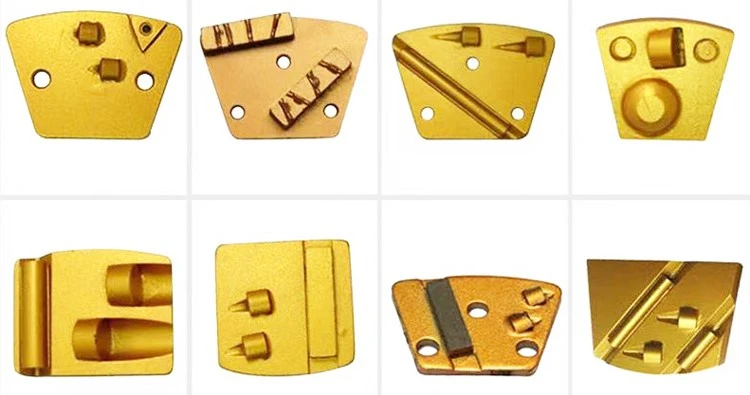
HuiceTools supply Diamond Grinding Shoes Segment with PCD.
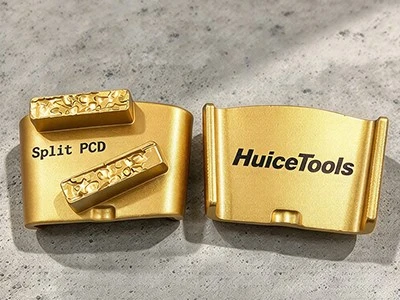
Split-PCD Diamond Grinding Shoes on EZ change plate of HTC grinder
Four Practical Payoffs
1. Dramatically faster coating removal
With its sharp edge, a PCD segment strips thick coatings in a single pass - up to 1–4 mm of epoxy or adhesive per pass. Fewer back-and-forth passes means production rates far beyond conventional diamond tooling, which is exactly what large-scale warehouse and plant floor refurbishment projects demand.
2. No more glazing or loading
Against the classic "segment killers" - epoxy, carpet adhesive, elastomeric waterproofing membranes, heavy paint - PCD's scrape-and-clear action sustains its cutting ability throughout the job. No more constant stops to clean or swap segments.
3. Long service life, lower total cost
Three to five times the life of conventional segments means fewer tooling changes, less downtime, and lower labor cost; the impact resistance further reduces the risk of a chipped insert writing off the whole tool.
4. Controlled cutting that protects the concrete slab
PCD is designed to strip the surface coating, not to aggressively eat into the substrate. It leaves the cementitious surface intact, so once the coating is gone you can move straight into the next diamond-grinding step with a predictable, flat profile - minimizing later leveling work.
The Industry-Standard "Hybrid" Design
In practice, PCD floor tools are rarely pure PCD. The standard design is a PCD + diamond hybrid segment:
The PCD inserts sit slightly proud of the diamond grit - they contact the floor first and handle the coating removal, while the diamond segment behind them lightly levels the concrete substrate. Two jobs, one pass.
An Important Caveat: PCD Is Not for Polishing Concrete!
This is the most common rookie mistake. A PCD segment is extremely aggressive and leaves deep scratches in the slab. Its job is the first step of the process: heavy removal and coating stripping (surface prep).
✓ Where PCD belongs
Floor refurbishment - fast removal of thick epoxy, polyurethane, mastic, carpet adhesive, asphalt, tile adhesive, old paint layers, and waterproofing membranes.
✗ Where it does not
Grinding and leveling bare concrete, or fine grinding and polishing of terrazzo or polished concrete floors - those stages belong to conventional metal-bond diamond segments, working progressively through the grit sequence.
PCD for initial stripping → Metal-bond diamond segments for grinding & leveling → Resin-bond pads for honing & polishing
The One-Sentence Summary
Embedding PCD in floor grinding segments serves one core purpose: replacing abrasive grinding with shear scraping to strip thick, gummy coatings fast, eliminate glazing and loading, dramatically boost removal rates, and extend tool life - it is a purpose-built structure for the surface-prep stage of floor refurbishment, not a polishing tool.
The next time you're staring at a glazed-over segment and a layer of old epoxy that refuses to come off, you'll know exactly who to call onto the floor.
Send Inquiry