

A Russian Research Institute Has Developed A Method For Encapsulating Nuclear Waste Using Nanodiamonds.
Jan 17, 2026
Leave a message
Scientists at the Institute of Geochemistry and Analytical Chemistry of the Russian Academy of Sciences (GEOHI RAN) recently announced that they have for the first time proposed using nanodiamonds synthesized via an explosive method to enhance the performance of mineral-like magnesium-potassium-phosphate composites prepared at room temperature for the fixation and containment of radioactive waste. By adding nanodiamonds to MKF composites, researchers successfully reduced the material's porosity while simultaneously improving its mechanical strength, thermal conductivity, and resistance to radionuclide leaching. The relevant research results have been published in the international journal *Journal of Composites Science*.
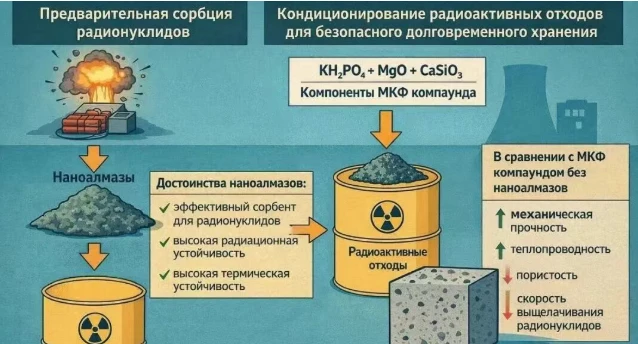
Nuclear waste must be converted into a chemically and radioactively stable solid matrix before final disposal to prevent radionuclide leakage into the environment. MKF composites are a promising material for solidifying nuclear waste and have previously been validated in the GEOHI RAN laboratory.
In this study, scientists proposed introducing nanodiamonds into MKF composites to enhance their performance. Nanodiamonds, with their large surface area and radiation-resistant and high-temperature-resistant properties, are excellent adsorbents for radioactive nuclides. The research team first used nanodiamonds to pre-adsorb actinides (such as plutonium-239 and uranium-238) and rare earth elements (e.g., europium) from simulated radioactive waste, and then immobilized them in a MKF matrix.
Svetlana Fimina, a senior researcher and PhD in chemistry at the GEOKI RAN Radiochemistry Laboratory, commented: "This research, funded by the Russian Science Foundation (Project No. 24-13-00430), utilizes nanodiamonds to pre-adsorb actinides and fission products before solidifying them into MKF composite materials. This is a promising new method for improving the safety of geological disposal of nuclear waste. The results demonstrate the comprehensive positive impact of explosive nanodiamonds on the physicochemical properties of MKF composite materials." This composite material significantly improves resistance to leaching of radionuclides, reducing the leaching rates of plutonium-239, uranium-238, and europium by 3 to 8 times compared to the original MKF material. This improvement is primarily attributed to the pre-adsorption of radionuclides by nanodiamonds and their stabilizing retention within the material.
It is understood that the safe disposal of waste containing long-lived radionuclides is one of the key challenges in nuclear energy utilization. Magnesium-potassium-phosphate materials, due to their excellent solidification properties, are frequently studied for the solidification and resource recovery of nuclear waste, particularly for encapsulating radioactive elements within a stable magnesium-potassium phosphate matrix to reduce their migration and contamination. For example, magnesium-potassium phosphate cement can be used to solidify nuclear waste liquids or residues, achieving waste volume reduction and stabilization. However, the process itself involves complex chemical reactions and radioactive treatment, requiring efficient waste management technologies.
Send Inquiry