

Diamond Powder in Thermal Management: From Emerging Trend To Core Necessity
Sep 21, 2026
Leave a message
Diamond Powder in Thermal Management: From Emerging Trend to Core Necessity
As AI compute power continues to climb, heat has become one of the biggest constraints on chip performance, reliability and service life. With conventional metal heat sinks approaching their physical limits, diamond - a material that uniquely combines exceptionally high thermal conductivity with electrical insulation - is moving rapidly from the lab into industrial application. Diamond powder, the key link between raw material and end use, now sits at the center of this shift, and its prospects in thermal management are drawing increasing attention across the electronics industry.
The AI "heat wall" is turning diamond cooling into a necessity
As GPU power density rises, thermal management is extending from rack-level liquid cooling down to the chip itself. In February 2026, NVIDIA announced that its next-generation GPU chips would adopt a "diamond composite + liquid cooling" thermal solution - a clear signal that diamond has entered the top tier of the global computing supply chain.
Market research points the same way. Zhongtai Securities estimates the global market for diamond heat spreaders in high-end AI chips at roughly RMB 8.7 billion in 2026, growing to RMB 59.2 billion by 2030 - a compound annual growth rate of more than 50%. Huafu Securities sees the AI-computing diamond thermal market reaching RMB 48–90 billion by 2030, and once consumer electronics, electric vehicles and industrial applications are included, the long-term opportunity expands to a RMB 100 billion-plus market.
Why diamond is the ideal thermal material
Diamond has one of the highest thermal conductivities of any known material - up to 2,200 W/(m·K) theoretically, roughly five times that of copper and more than thirteen times that of silicon. What makes it truly special is the combination of high thermal conductivity and electrical insulation. This dual nature makes diamond a better fit than metals for precision electronic components: it pulls heat away quickly while preventing short circuits and electromagnetic interference - almost as if it were designed for high-power chip cooling.
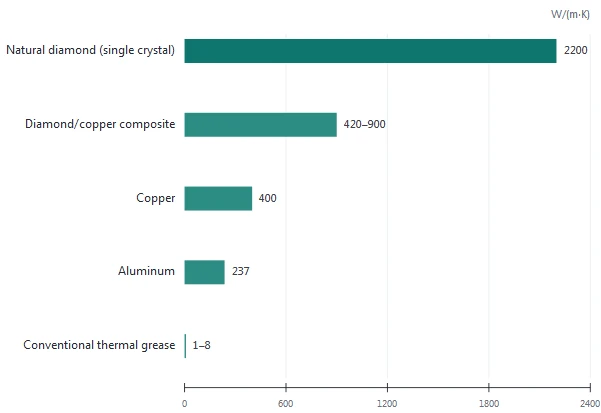
Thermal conductivity of diamond-based and conventional materials (W/(m·K)). Diamond: theoretical value per Economic Information Daily; diamond/copper composite: 420–900 per public reports; copper ≈ 400, aluminum ≈ 237; thermal grease: 1–8 typical range, barely visible at this scale.
How diamond powder is produced
Industrial diamond powder is manufactured primarily by the high-pressure, high-temperature (HPHT) method. Graphite is converted into diamond at 1300–1700 °C under pressures of 5–7 GPa, and the resulting material is then crushed, purified and graded into micron- or nano-sized powders. Because powder can be readily incorporated into other materials - as a filler or a reinforcing phase - it serves as the fundamental building block for most diamond-based thermal solutions.
Two mainstream application routes
Thermally conductive fillers. Diamond powder can be added to thermal greases (pastes), thermal pads and other thermal interface materials (TIMs), filling the tiny gaps between heat-generating components and heat sinks to significantly improve interfacial heat transfer. In China, companies such as Feimeng Diamond, Henan Tianyou and Tianjian Carbon Materials are already active in this space.
Diamond/metal composites. Diamond particles can be compounded with copper, aluminum or other metals to produce heat-spreading substrates and heat sinks. Diamond/copper composites, for example, achieve thermal conductivities of 420–900 W/(m·K) - outperforming pure copper (about 400 W/(m·K)) - while offering a coefficient of thermal expansion (CTE) that better matches chip packaging materials. This makes them well suited to high-heat-flux applications such as AI chip packaging, high-power laser diodes, LEDs and IGBT modules. The technology has already moved beyond the laboratory: in April 2026, diamond/copper composite modules were deployed at scale for the first time at a national supercomputing hub in Zhengzhou, improving chip-module heat-transfer capability by 80% and cutting chip temperature by 5 °C.
The biggest hurdle: interface thermal resistance
The industry's greatest challenge remains the interface thermal resistance between diamond powder and the matrix material. If the two phases do not bond well, heat cannot flow across the interface efficiently. Current solutions center on surface modification - such as silane coupling agent treatment and surface functionalization - combined with process optimization, including metal coating of diamond particles and improved composite fabrication routes.
Outlook: from emerging trend to core necessity
China is already the world's largest producer of synthetic diamond, accounting for more than 95% of global output, with Henan province alone contributing over 80% of national capacity - a complete foundation from raw material to application. As demand from AI chip cooling becomes increasingly certain, a growing number of companies are building out the full value chain - from diamond raw material and powder to finished composites - and industrialization is clearly accelerating. In the era of compute-driven innovation, diamond powder, with its unique combination of high thermal conductivity and electrical insulation, is set to play an increasingly critical role in high-end thermal management: moving from an emerging trend to a core necessity.
Disclaimer: This article is provided for general information only and does not constitute investment advice or a basis for business decisions. Technical parameters, market data and company information cited herein are drawn from public sources and industry reports; we make no representation as to their accuracy, completeness or timeliness. The actual performance of diamond-based thermal products depends on manufacturing processes, formulations and application conditions, and thorough testing and evaluation are recommended before adoption. For republication or citation of this article, please contact us and credit the source.
Sources
- China News Service - NVIDIA to adopt diamond composite cooling: m.chinanews.com.cn
- 36Kr - AI-chip diamond heat spreader market forecasts (Zhongtai Securities): 36kr.com
- Securities Times - market forecasts (Zhongtai, Huafu Securities): stcn.com
- Economic Information Daily - diamond thermal conductivity and industry output: jjckb.cn
- Ningbo Institute of Materials Technology and Engineering (CAS) - first large-scale diamond/copper deployment: nimte.ac.cn
Send Inquiry