

Six Major Application Fields Of Diamond
Sep 22, 2026
Leave a message
From lab-grown diamonds on your finger to heat spreaders inside AI chips and sensors for tomorrow's quantum computers, diamond is evolving from a gemstone into a limit-performance material. Performance pushed to the max: diamond, the ultimate all-rounder of advanced materials. It all starts at the atomic level. Each carbon atom forms covalent bonds with four neighbors through sp³-hybridized orbitals, building a three-dimensional face-centered cubic (FCC) network. At room temperature and ambient pressure, the lattice constant is just 3.5667 Å, with among the highest atomic densities and atomic bond energies (~7.4 eV) of any material. This near-perfect crystal structure lets diamond hold records at once for hardness, thermal conductivity, optical transmission and bandgap - and has spawned six major application fields.
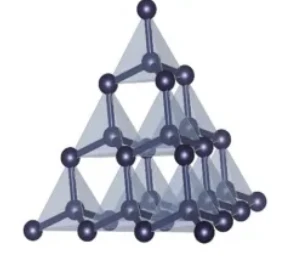
(Diamond crystal structure)
1. Jewelry: lab-grown diamonds enter mass production
High-pressure, high-temperature (HPHT) synthesis remains the mainstream route to lab-grown diamonds, while chemical vapor deposition (CVD) has advanced rapidly in recent years - costs have fallen sharply, process stability has improved markedly, and products are now mass-produced and shipped at industrial scale. Gem-grade diamond is reaching the mass market at far friendlier price points.
2. Mechanical: the "teeth of industry"
With small carbon atoms, strong covalent bonds and short bond lengths, diamond is the hardest known natural material (~1×10⁴ kg/mm²). Its extreme hardness and chemical stability make it the go-to cutting-tool tip for hard and brittle materials as well as hard, tough metals, along with oil-drilling and exploration drill bits and superabrasives. Its extremely low coefficient of friction also suits metal wire-drawing dies - hence its nickname, the "teeth of industry."
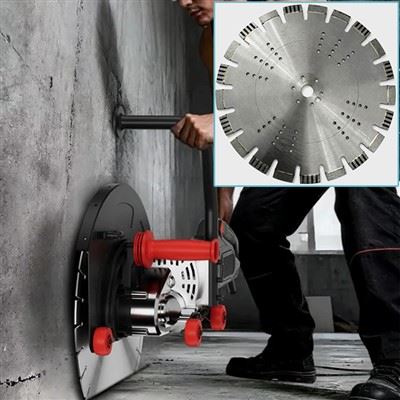
Diamond saw blade for cutting concrete walls
About huicetools: a professional manufacturer of diamond tools, founded in 2006. With years of hands-on experience, we sell factory-direct at highly competitive prices. Our product line covers diamond saw blades, diamond grinding blocks, diamond drill bits and a full range of diamond tools.
3. Thermal: breaking through chip heat limits
In the age of "compute is king," the heat generated by chips is the key bottleneck holding back further performance gains, and copper-based heat sinks and heat pipes are approaching their limits. Diamond reaches thermal conductivities of up to 2,000 W/(m·K), while its coefficient of thermal expansion is only ~0.8×10⁻⁶/K - dimensionally stable through both heating and cooling cycles. It has become a critical thermal-management material, deployed in four main forms:
- Diamond fillers - added to thermal gels and pads to fill the micro-gaps between chips and heat sinks.
- Diamond substrates - semiconductor functional layers are grown epitaxially on diamond, for low thermal resistance and efficient heat dissipation.
- Diamond heat spreaders - standalone cooling components in back-end packaging, compatible with existing chip designs and packaging lines.
- Diamond microchannel cooling - a deep integration of diamond technology and liquid cooling; materials and structures are co-designed to intercept heat at the source and shunt it away at high speed, directly addressing the thermal challenges of AI servers and chips.
4. Optical: the ideal infrared-window material
Diamond has the broadest transmission spectrum of any solid material - transparent from 225 nm in the ultraviolet out to 25 µm in the infrared (except the 1.8–2.5 µm band), and even into microwave wavelengths. Combined with strong radiation resistance, high hardness, high thermal conductivity and a low expansion coefficient, it makes the ideal material for modern infrared optical windows, including laser windows, high-power microwave windows and Raman laser applications.
5. Acoustics: a new substrate for high-end audio devices
In high-end audio, 5G/6G communications and precision sensing, traditional acoustic materials are held back by limited high-frequency extension, higher distortion, limited power handling and unstable precision. CVD diamond combines an ultrahigh Young's modulus, ultrahigh sound velocity and low density - three natural advantages that make it the ideal substrate for high-fidelity acoustic devices, surface acoustic wave (SAW) filters and high-precision acoustic sensors.
6. Electronics & semiconductors: the "ultimate semiconductor"
Diamond boasts a wide bandgap of 5.5 eV, an electrical resistivity of around 1×10¹² Ω·m and a dielectric constant of 5.5 - making it an ideal detector material in harsh, high-radiation environments. Compared with silicon, GaN and SiC, it also offers higher carrier mobility, a higher breakdown electric field and far greater thermal conductivity; its intrinsic thermal conductivity and bulk-material mobility are both the highest of any natural material. Effective doping can give it good n-type or p-type behavior, supporting the industry's hopes for diamond as the "ultimate semiconductor." Beyond that, quantum diamond - diamond containing high-quality nitrogen-vacancy (NV) color centers - is accelerating into quantum computing, quantum communication and quantum precision sensing. NV centers offer nanoscale spatial resolution and exceptional sensitivity, and can be extended to quantum sensing under extreme high-pressure conditions.
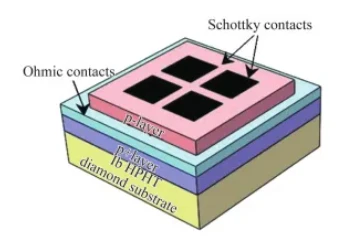
(Schematic diagram of diamond Schottky diode structure)
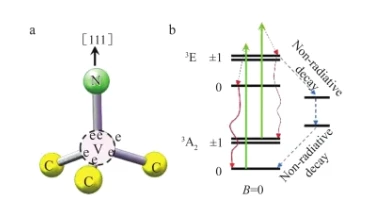
(a) Schematic diagram of NV color center atomic structure; (b) NV color center energy level structure and optical transition
Outlook
Whether it is today's hard requirement for cooling compute equipment or tomorrow's exploration of quantum technology, diamond plays a pivotal role. As synthesis processes keep improving and application technologies keep breaking through, this "all-rounder material" will release even more value, helping high-end manufacturing and frontier technology reach new heights.
Disclaimer: This article is provided for general information only and does not constitute investment advice or a basis for business decisions. Technical parameters and industry information cited herein are drawn from public sources and industry compilations; we make no representation as to their accuracy, completeness or timeliness. Actual product performance depends on processes, formulations and application conditions, and thorough testing and validation are recommended before adoption. For republication or citation, please contact huicetools and credit the source.
Send Inquiry