

Comprehensive Overview Of Coated Diamond Tools
Jul 01, 2026
Leave a message
Origins of Coated Diamond Tools:
In the 1960s, electroless plating and electroplating were employed to coat diamond surfaces with layers of Cu, Ni, and their alloys; these methods achieved significant success when applied to resin-bonded diamond abrasive tools. With the advancement of metal-bonded diamond tools, a need arose for coatings capable of forming strong metallurgical bonds with both the diamond particles and the metal matrix. Consequently, methods such as chemical vapor deposition (CVD), physical vapor deposition (PVD), vacuum micro-evaporation, plasma sputtering, magnetron sputtering, and mechanical coating were rapidly adopted to apply layers of strong carbide-forming elements, alloys, composite materials, or high-melting-point compounds onto diamond surfaces, yielding excellent results. Furthermore, to enhance bonding between ceramic matrices and diamond or CBN (cubic boron nitride) abrasives, specialized techniques were developed to apply coatings of ceramic/silicate materials-such as glass phases, corundum, or SiC-onto the surfaces of the diamond and CBN particles.
Comprehensive Overview of Coated Diamond Tools
I. Definition and Core Principles
Coated Diamond Tools-distinct from metal or resin grinding blocks featuring an integrated sintered matrix-are created by applying a single layer of diamond abrasive particles to a steel, aluminum, or cemented carbide substrate.
This is achieved through one of three processes:electroplating,vacuum brazing, or CVD (Chemical Vapor Deposition) thin-film deposition. These tools feature only a surface layer of diamond without a deep matrix reservoir for abrasive storage; the industry collectively refers to them as "single-layer coated diamond tools."
Core characteristics: Single diamond layer, high abrasive protrusion, ample chip clearance space, high sharpness, and suitability for intricate shaping or complex profile machining.
- Electroplated diamond tools (most common)
- Vacuum brazed diamond tools
- CVD diamond coated tools

(CNC special brazed diamond stone carving knife)
II. Classification, Structure, and Pros/Cons of the Three Main Coating Processes
1. Electroplated Diamond Tools (Nickel coating with mechanical embedding; highest market volume)
Process Principle
- After substrate pretreatment, the tool is immersed in an electroplating bath. Nickel metal deposits uniformly, partially encapsulating and anchoring the diamond particles to the substrate surface; the bond is purely mechanical, without metallurgical fusion.
Structural Characteristics
- Single diamond layer with 50%–60% abrasive protrusion; thin coating and low overall profile, allowing for the creation of arc shapes, internal bore tools, and complex contours.
Advantages
- Simple production, low cost, and fast delivery;
- Extremely high initial sharpness; minimizes edge chipping when cutting stone or ceramic tiles;
- Capable of machining highly complex shapes: arc grinding wheels, internal hole drill bits, stone edge-profiling wheels, and waterjet guide wheels;
- High dimensional accuracy; suitable for small-batch precision machining and manual grinding/touch-up work. Drawbacks
Weak diamond retention;
- diamonds tend to detach in large patches under heavy pressure, dry grinding, or when processing rebar;
- Discarded once the single layer of abrasive is consumed; cannot be refurbished;
- Unsuitable for long-term, heavy-load mass production on assembly lines.
Common products for stone/construction
- Electroplated wet polishing pads, tile cutting blades, stone arc-profile grinding wheels, glass grinding discs, thin-walled core bits, stone carving/milling cutters.
2. Vacuum-brazed diamond tools (High-end coating with metallurgical bonding)
Process principle
- Titanium-coated diamond particles combined with nickel-chromium brazing filler; fused in a high-temperature vacuum furnace; the filler forms metallurgical chemical bonds with both the diamond and the steel substrate, firmly encapsulating the base of the diamond.
Structural features
- High diamond protrusion (70%–80%); wide chip-clearance channels; high retention (diamonds do not easily detach); high-strength single-layer structure.
Core advantages
- Retention force is 3–5 times that of electroplated tools; suitable for dry cutting and heavy-load grinding;
- Excellent heat dissipation; diamond grains do not easily burn out; service life when processing concrete, granite, or thick tiles far exceeds that of electroplated tools;
- Fast, effortless cutting without clogging; minimal edge chipping when cutting slabs;
- Suitable for assembly lines and heavy-duty construction using angle grinders.
Drawbacks
- High equipment investment and high unit price; cannot be recoated.
Common products
- Brazed dry-cutting saw blades, concrete grinding cup wheels, stone antiquing rollers, thin-walled bits for reinforced concrete, road and bridge grinding wheels.
3. CVD diamond thin-film coated tools (Pure diamond film, precision machining)
Process principle
- Hot-filament chemical vapor deposition (CVD) grows a 4–40μm pure diamond film on the surface of cemented carbide tools; no binder is used, resulting in an integral, all-diamond surface layer.
Application scenarios
- Precision milling of graphite, carbon fiber, high-silicon aluminum alloys, and zirconia ceramics; rarely used for grinding large stone slabs; virtually unused in the stone industry.
Limitations
- Cannot process ferrous metals (high temperatures trigger graphitization); extremely high cost; not widely adopted in the stone industry.
III. Coated Diamond Tools vs. Sintered Diamond Grinding Blocks (Key Distinctions)
Table
Comparison Item Coated Diamond (Electroplated / Brazed) Sintered Metal / Resin (Frankfurt / Horseshoe Blocks)
Diamond Distribution Single surface layer only; no deep-layer reserve Diamond distributed throughout the matrix; multi-layer consumption
Protrusion Height Very high; smooth chip evacuation Relatively low; prone to clogging with dust
Sharpness Extremely fast/effortless initial cutting Moderate; requires "dressing" (break-in) to stabilize
Service Life Short; discarded once the surface layer wears out Long; continuous consumption of diamond within the matrix
Load Capacity Electroplated: light loads; Brazed: medium-to-heavy loads Suitable for 24-hour continuous heavy-duty grinding on production lines
Suitable Shapes Complex profiles, arcs, inner holes, fine edge finishing Batch polishing and leveling of large flat slabs
Refurbishment Cannot be recoated; single-use Can be restored via re-sintering (hot pressing)
Typical Products Profile wheels, thin-wall core bits, hand-held pads, carving bits Frankfurt blocks, metal rough-grinding blocks, saw blade segments
IV. Major Applications in Stone and Concrete Industries
1. Stone Processing Sector
- Complex profile and arc processing: Roman edges on countertops, curved bay window sills, molding profiles (using brazed/electroplated grinding wheels);
- Fine edge finishing, chamfering, and hole cutting: Electroplated thin-wall core bits and edge-trimming discs (prevents chipping on marble/tiles);
- After-sales repair and spot refurbishment: Electroplated wet-polishing pads, hand-held machines for localized scratch repair;
- Small-scale carving and relief milling: Electroplated diamond milling cutters for intricate pattern carving;
- Dry cutting of thin slabs and sintered stone: Brazed continuous-rim saw blades (chip-free cutting).
2. Construction Concrete and Flooring Sectors
- Concrete wall/floor grinding: Brazed diamond cup wheels, trapezoidal floor grinding segments;
- Plumbing/electrical hole cutting: Electroplated or brazed thin-walled core bits for rapid drilling in brick walls and plain concrete;
- Old floor coating and epoxy removal: Brazed coarse grinding discs;
- Asphalt and road surface grinding/refinishing; shaping rollers for stone tumbling/profiling.
V. Summary of Core Performance Pros and Cons
General Advantages (Shared by Electroplated & Brazed Tools)
- Single-layer diamond structure with high protrusion; low grinding resistance and fast material removal; minimal edge chipping on the finished surface;
- Tool bodies can be fabricated into complex curved shapes, internal holes, or narrow slots, making them suitable for irregular, non-standard machining;
- No lengthy break-in period required; sharp immediately upon mounting; simple setup;
- Ample chip clearance space; stone dust and concrete aggregates are less likely to clog the working surface.
Specific Drawbacks of Electroplated Tools
- Poor impact resistance; unsuitable for dry grinding or heavy pressure; prone to diamond loss when processing granite or reinforced concrete;
- Short service life; suitable only for light-duty, small-batch, wet-processing finishing operations.
Specific Advantages of Brazed Tools
- Metallurgical bonding provides impact resistance; suitable for both dry and wet use; capable of processing reinforced concrete and hard granite;
- Service life is 2–4 times that of electroplated tools; suitable for high-volume processing at construction sites and stone factories.
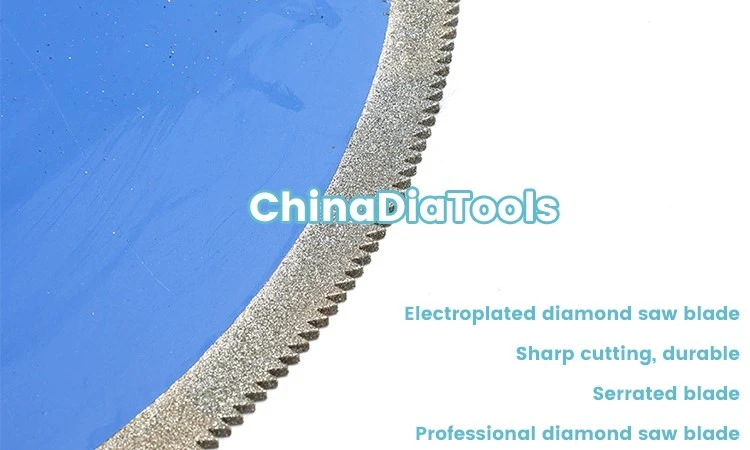
(Electroplated Diamond Saw Blade)
VI. Practical Selection Guidelines
- Precision edge trimming and hole cutting for indoor marble, sintered stone, and tiles → Use electroplated diamond tools for a smooth, chip-free finish;
- Outdoor dry cutting/processing of concrete, rebar, and thick granite → Use vacuum-brazed coated tools;
- Coarse surface grinding and leveling on fully automated large-slab production lines → Use sintered metal or resin grinding segments; coated tools are not recommended;
- Strictly avoid electroplated tools for prolonged dry grinding or heavy-pressure grinding; the entire diamond layer is prone to shedding, rendering the tool useless;
- Adequate water cooling is recommended throughout the use of coated tools to prevent diamond carbonization and detachment caused by high temperatures.
Send Inquiry