

Test Method For Particle Size Distribution Of Synthetic Diamond Powder
Feb 16, 2023
Leave a message
The detection methods of diamond powder size distribution mainly include image method, sedimentation method, centrifugal method, laser method, Coulomb method, etc.
1. Image method
Image method is a method to detect the grain size of diamond powder by particle image analyzer.
Particle image analyzer generally consists of optical microscope, camera, computer and analysis software. When particle size measurement is carried out, the sample is made into observation sample by slides and glycerine, then placed under optical microscope for observation, and the sample picture is taken by camera, then transferred to computer for particle size analysis by analysis software (as shown in the following figure).
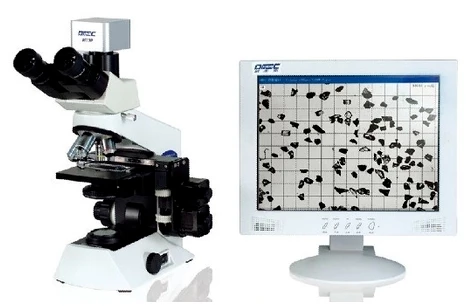
The advantages of image method are intuitive detection, analysis of particle morphology and so on. The disadvantages of image method are small sample amount, poor representation of test results, tedious operation and long time-consuming.
2. Settlement method
Particle size measurement by sedimentation is an instrument and method to measure particle size distribution by the sedimentation rate of particles in liquid. A method for measuring the size distribution of diamond powder according to the settling speed of particles with different particle sizes in liquids.
Its basic process is to put the sample into a certain liquid to make a certain concentration of suspension, the particles in the suspension will settle under the action of gravity.
The settling speed of particles is related to the size of particles. The settling speed of large particles is fast and that of small particles is slow. The settling speed of particles is indirectly reflected by measuring the change rate of light intensity in suspension at different times, and the size distribution of particles is calculated. However, it is difficult to directly measure the settling speed of particles in the actual measurement process. Therefore, it is usually used to measure the rate of change of suspension concentration at a depth below the liquid level to indirectly determine the settling speed of particles and then to measure the particle size distribution of samples.
3. Centrifugation
For finer particles, gravity settling method needs longer settling time and is greatly affected by convection, diffusion, Brownian motion and other factors during settling process, which results in larger measurement error.
In order to overcome these problems, centrifugal settling method is usually used. Settling tank is placed in a high-speed rotating disc to accelerate the settling speed of particles, thus greatly shortening the measuring time, improving the measuring accuracy and making it possible to detect ultrafine particles. Centrifugal particle size analyzers now operate at speeds of over 20,000 rpm. The detection limit is nanometer.
4. Laser method
The laser method measures the size distribution based on the physical phenomenon that particles scatter light. In practical application, the measuring data are stable due to the short measuring time, especially for the particle size less than 150. μ M powder measurement has been recognized in practical application.
5. Kurt Method
The Kurt method, also known as resistance method, uses the principle of small-hole resistance. When the micro-particle passes through a small hole, the micro-particle occupies part of the space in the small hole and discharges the conductive liquid in the small hole, which changes the resistance at both ends of the small hole.
The instrument processes these resistance signals and counts the size distribution. This measurement method is suitable for measurements of powder samples with uniform particle size (i.e. narrow particle size distribution) and for measurements of the size and number of rare solid particles in water. It has the advantages of high resolution, fast measuring speed and simple operation. But there are also some shortcomings such as small dynamic range and insufficient lower measurement limit.
Send Inquiry