

The Comprehensive Impact of Diamond Concentration on Diamond Tool Performance
Jun 23, 2026
Leave a message
Diamond concentration plays a crucial role in the performance of diamond tools. Today, Huice Tools shares insights into how diamond concentration affects six key performance areas, along with further information on the subject.
I. Defining Industry Concentration Standards
1 General standards for diamond tools used on stone and concrete:
- 100% Concentration = 0.88 carats of diamond per cubic centimeter of the tool matrix.
- The essence of concentration: The number of diamond particles within a given volume of the matrix. Concentration is categorized into three levels: low (60%–80%), medium (90%–110%), and high (120%–150%).
- The core trade-off: Higher concentration results in reduced sharpness but increased tool life; lower concentration leads to faster cutting but shorter tool life.
II. Impact on Six Key Performance Areas
1. Cutting/Grinding Sharpness
Inversely Correlated
1) Low Concentration (60%–80%)
- Fewer diamond particles in the matrix and wider spacing between them mean each particle bears a higher load and cuts deeper. Grinding resistance is low, feed is smooth and effortless, and sharpness is optimal.
- Applications: Soft marble, luxury stone, red brick, and lightweight concrete; ideal when processing feel is prioritized over ultra-long tool life.
2) Medium Concentration (90%–110%; Industry Standard)
- Balanced particle distribution offers a compromise between sharpness and wear resistance. It prevents slipping while maintaining moderate wear rates; this is the standard specification for most stone grinding blocks and general-purpose concrete core bits.
3) High Concentration (120%–150%)
- Diamond particles are densely packed and interfere with one another; each particle makes only a shallow cut. Grinding resistance increases, leading to potential slipping and sluggish cutting action, resulting in a noticeable drop in sharpness.
- Applications: High-speed continuous polishing and precision processing of thin materials; prioritizes tool life over cutting speed.
2.Service Life
Positive Correlation
- Higher concentration means a greater total volume of diamond per unit volume; this ensures an ample supply of abrasive particles for cutting, significantly increasing the tool's total processing area and drilling distance, thereby extending the replacement cycle.
- Low concentration implies a smaller total volume of diamond; particles wear down and detach rapidly, quickly leading to large areas of exposed matrix devoid of diamond, resulting in the tool being scrapped.
Example: A concrete drill bit with 100% concentration has a service life approximately 40% longer than one with 70% concentration; high-gloss resin grinding blocks typically use high concentrations to ensure a lasting high-gloss finish.
3. Matrix Diamond Retention and Grit Loss Probability
1) Drawbacks of excessively high concentration
- A large amount of diamond crowds out the space for the metal bond, thinning the metal layer that encapsulates the diamonds and significantly reducing retention force; under processing vibrations and impacts, whole particles easily detach, causing extensive grit loss.
- High-concentration formulas must utilize titanium-coated diamonds and cobalt-based bonds to compensate for retention force.
2) Moderate / Low concentration
- There is ample spacing between diamonds, allowing the metal matrix to fully encapsulate the particles for a firm grip; grit loss is rare under normal operating conditions, and the formula offers greater tolerance.
4. Working Surface Heat Dissipation and Risk of Burning Segments/Blades
- High concentration: Diamonds are densely packed, narrowing the channels for debris removal and heat dissipation; debris easily clogs the gaps between particles, making it difficult for frictional heat to escape. When processing hard granite or reinforced concrete, high temperatures are more likely to cause diamond ablation and failure due to particle graphitization.
- Low concentration: Large gaps between particles facilitate smooth flow of cooling water and stone slurry, resulting in effective heat dissipation; the tool is less prone to overheating or burning during continuous, long-term processing.
5. Processed Surface Finish and Scratch Characteristics
- High concentration: A high number of particles produces fine, uniform cutting patterns and shallow surface scratches, resulting in higher gloss after polishing; high concentrations are commonly used in high-gloss resin grinding blocks and fine-grinding brushes for leather-finish surfaces.
- Low concentration: Fewer abrasive particles and deeper cutting action; the slab surface is prone to coarse, deep scratches that require multiple subsequent fine-grinding steps to conceal. Exercise caution when using low-concentration coarse grinding blocks on luxury stones or light-colored stones.
6. Production Costs
Diamond is the most expensive raw material component:
- High-concentration formula: High diamond content significantly increases raw material costs, resulting in a higher selling price for the tool.
- Low-concentration formula: Reduces diamond usage and lowers costs; suitable for low-end projects and disposable, short-term consumables.

Huice Tool produces and researches high-performance diamond ring saws, using high-quality diamond abrasive particles with high diamond concentration, stable saw blade performance, and high cost-effectiveness.
III. Logic for Selecting Standard Concentrations by Tool Category
1. Metal-bond coarse grinding blocks
Granite Frankfurt / Horseshoe-style metal blocks
- Concentration: 90%–100% (Medium concentration)
- Requirements: Balances cutting speed and tool life; excessively low concentration leads to rapid wear, while excessively high concentration results in sluggish grinding performance.
2. Metal grinding blocks for soft stone / luxury stone
- Concentration: 70%–80% (Low concentration)
- Purpose: Enhances sharpness, reduces deep scratching, and prevents damage to soft mineral veins caused by aggressive cutting.
3. Resin fine-grinding and high-gloss polishing blocks
(Horseshoe / Frankfurt style)
- Concentration: 110%–130% (Medium-high concentration)
- Polishing does not require heavy cutting; it relies on a large number of fine particles for uniform micro-polishing, continuously enhancing gloss and extending the tool's polishing lifespan.
4. T1 Diamond-filled nylon antique-finish brushes
- Concentration: 80%–90% (Medium-low concentration)
- Ensures flexible cutting action by the bristles to avoid scratching the slab surface while controlling filament costs.
5. Concrete core drill segments
Standard random distribution
- Standard walls: 95%–105%;
- Thick rebar / bridge pile foundations: 110%–120% (increased concentration to extend lifespan).
6. Arix concrete drill segments
(Ordered arrangement)
- Concentration is consistently lower (75%–90%);
- the ordered arrangement ensures uniform particle distribution, eliminating the need for high concentrations and preventing particle crushing or fracturing due to overcrowding.
IV. Optimal Matching of Diamond Concentration and Matrix Hardness
- Soft matrix (high-copper formula) + Low diamond concentration: Extremely sharp; suitable for soft stone and red brick; downside is short service life.
- Medium-hardness matrix + Standard (100%) concentration: Versatile, all-purpose combination; mainstream choice for mass processing of stone and concrete.
- High-hardness, wear-resistant matrix (high cobalt/tungsten content) + High diamond concentration: Exceptionally long service life; suitable for hard granite and high-strength reinforced concrete; downsides include slower cutting speeds and the need for ample water cooling.
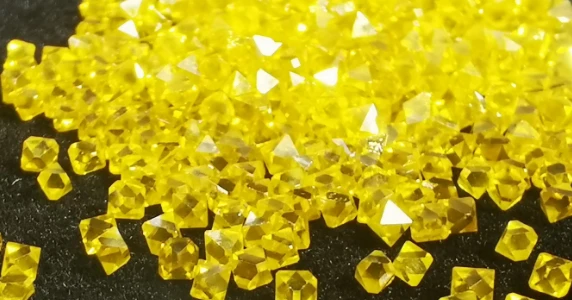
(Diamond abrasive grains under microscope)
V. Summary
- Lower diamond concentration → Faster cutting, good heat dissipation, lower cost, deeper scratches, shorter service life, reduced risk of diamond loss (grit shedding);
- Higher diamond concentration → Longer service life, finer surface finish with high gloss, less frequent tool replacement, higher cost, slower cutting, prone to clogging and overheating, risk of grit shedding due to insufficient bond retention;
- Selection Guide: Choose low concentration for soft materials and when prioritizing processing efficiency; choose medium-to-high concentration for hard materials, long-term mass production/polishing, and heavy-duty construction projects.
Send Inquiry