

What is the airtec diamond grinding shoes?
Oct 23, 2026
Leave a message
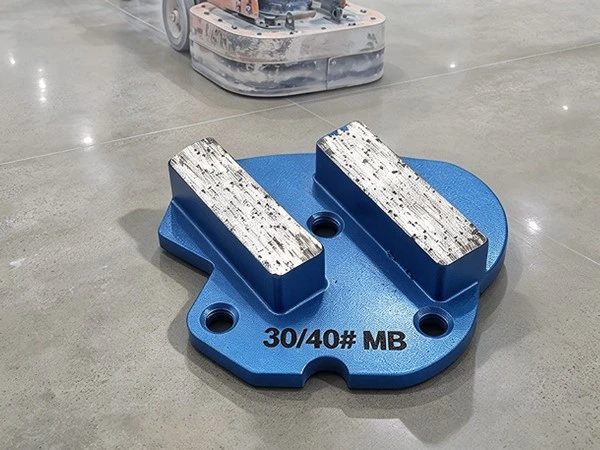
Airtec diamond grinding shoes(also called as arictec concrete grinding plate, metal bond diamond grinding pad) are replacement consumables designed for Airtec concrete floor grinders. They bolt onto the grinder's base plate and do the actual cutting - stripping old coatings, grinding down high spots, leveling uneven concrete and preparing surfaces for polishing or coating. For floor contractors specifying Airtec equipment, choosing the right shoe is the single biggest lever on grinding speed, finish quality and total cost per square meter.
1. What are Airtec diamond grinding shoes used for?
Airtec grinding shoes are used across the full range of concrete surface preparation work: rough grinding, epoxy / paint / glue stripping, concrete leveling, terrazzo renovation and coating removal. They are the working end of the machine - the diamond segment contacts the floor while the grinder provides rotation and pressure.
2. Are Airtec grinding shoes M6 bolt-on?
Yes. Most standard Airtec diamond grinding shoes use an M6 bolt-on mounting system, matching the original Airtec grinder plate hole pattern. When sourcing aftermarket shoes, bolt-hole spacing and flange dimensions must match the original specification exactly - a misaligned hole means the shoe wobbles, unevenly wears and can come loose under load.
3. PCD shoes vs metal bond diamond shoes - what's the difference?
- PCD shoes use polycrystalline diamond cutters. They are built for coating removal - stripping thick epoxy, carpet glue, adhesive and old paint from concrete floors. The PCD edge scrapes rather than grinds, so it does not clog on soft, sticky material.
- Metal bond diamond shoes contain diamond grit held in a sintered metal matrix. They are for concrete grinding, leveling and polishing preparation - removing high spots, smoothing trowel marks and opening the concrete surface.
Hybrid shoes that combine PCD cutters with smaller diamond segments are also available: they strip coatings first and leave the underlying concrete slightly opened in a single pass.
4. Which bond for hard concrete?
Soft bond shoes are recommended for hard concrete. In hard concrete, a hard bond matrix wears too slowly, so worn diamond grains cannot break out and expose fresh sharp ones - the segment glazes over and stops cutting. A soft bond erodes at the right rate to renew the abrasive surface automatically. Conversely, soft concrete calls for a hard bond to avoid premature wear. Reputable manufacturers offer a full bond range (soft / medium / hard) matched to concrete hardness.
5. Can PCD shoes remove epoxy and glue?
Yes. Airtec PCD grinding shoes are the standard choice for removing epoxy coatings, carpet glue, tile adhesive, thin paint and other polymer-based layers from concrete. Because PCD cuts by shearing rather than friction, it generates less heat and does not gum up on soft, sticky coatings the way a metal-bond diamond segment would.
6. Left rotation vs right rotation shoes
Left- and right-handed shoes are shaped to match the rotation direction of the grinder plate. They are used in pairs - one left and one right on each plate - to balance cutting force, reduce vibration and produce a smoother, more even grind. Mixing up left and right pieces causes uneven wear and side-loading on the machine. They are normally sold as matched kits.
7. Which grit for rough grinding?
For concrete rough grinding, the common starting grits are 6#, 16# and 30#. These coarse grits remove high spots and old coatings quickly. The sequence then moves through medium grits (60#–120#) for leveling and fine grits (200#+) for polishing preparation. Grit choice should always match the condition of the floor and the end finish.
8. Are Airtec shoes interchangeable with Redi Lock, Lavina or other systems?
No. Airtec grinding shoes are built around the Airtec mounting base, which has a unique hole pattern and fixing structure. They are not interchangeable with Redi Lock, Lavina, Scanmaskin or other common quick-lock systems. If you run a mixed fleet, source the correct shoe type for each machine - do not force-fit.
9. How long do Airtec diamond segments last?
Service life depends on concrete hardness, grinding pressure, machine speed and the bond selected. As a rough guide, metal-bond diamond segments typically last 800–2,000 m² per set under normal conditions; PCD coating-removal shoes vary widely depending on the thickness and type of coating. Bond formulation is the biggest lever on life - a matrix tuned to the concrete hardness typically outlasts a generic off-the-shelf shoe.
10. How to replace Airtec grinding shoes
- Power off the grinder and lock out the machine;
- Unscrew the M6 bolts and remove the worn shoes;
- Align the new shoes to the base-plate holes, confirming left / right rotation orientation;
- Tighten the bolts evenly in a cross pattern to seat the shoe flat against the plate.
11. Concrete vs terrazzo - which shoes?
Airtec shoes work on both concrete and terrazzo. For concrete, pick the bond according to hardness and the grit according to whether you are grinding, stripping or polishing. For terrazzo renovation, a medium bond and medium grit is usually the starting point, since terrazzo contains aggregate that wears segments faster than plain concrete.
Closing
Airtec diamond grinding shoes are a precision consumable: the right bond, the right grit, the correct left/right orientation and a clean bolt-on fit together decide whether a job finishes on schedule or stalls mid-floor. Contractors running Airtec equipment should treat shoe selection as an engineering decision, not a commodity purchase - the cost per square meter is dominated by bond life and cut rate, not by the sticker price of the box.
About huicetools: a professional manufacturer of diamond tools, founded in 2006. We produce compatible Airtec diamond grinding shoes - both metal-bond diamond segments and PCD coating-removal shoes - with mature formulas, strict quality control and factory-direct pricing. Our product line also covers diamond saw blades, diamond ring saw blade, diamond segment, diamond wall saw blade, diamond grinding blocks, diamond drill bits and a full range of diamond tools for construction applications.
Disclaimer: This article is adapted and rewritten from publicly available industry information for general reference only. Performance figures (service life, grit ranges, bond recommendations) are typical values and vary with concrete hardness, machine pressure, speed and operator technique. Always consult the tool manufacturer's specification and test on a small area first. We make no representation as to the completeness, accuracy or timeliness of this information, and this article does not constitute procurement advice. For republication or citation, please contact huicetools and credit the original source.
Send Inquiry