

Why Manganese Is Added to Diamond Tools?
Aug 22, 2026
Leave a message
Why Manganese Is Added to Diamond Tools
In diamond tools, the function of the metal binder (matrix) is to retain diamond particles and wear away at an appropriate rate during use, ensuring the continuous exposure of fresh diamond cutting edges. Although manganese is typically used in small quantities as an alloying element, it plays a crucial role in binder systems based on copper, iron, tungsten, and tungsten carbide. The primary objective of adding manganese is to improve sintering characteristics, interfacial bonding, and mechanical properties without damaging the diamonds or compromising other matrix performance metrics.
(Manganese element)
I. Significantly Lowering the Sintering Temperature of Copper-Based Binder Phases
Manganese has a melting point of 1246°C and possesses high hardness and strength, comparable to that of iron. It exhibits good mutual solubility with copper; notably, a Cu-Mn alloy with a manganese content of 33.7% has a melting point of only 871°C. This characteristic allows manganese to significantly lower the sintering temperature of copper-based binder phases.
For diamond tools, lowering the sintering temperature offers several advantages:
- Reducing the risk of diamond graphitization, oxidation, or thermal damage at high temperatures;
- Lowering energy consumption and improving process cost-effectiveness;
- Facilitating the formation of a denser and more uniform matrix microstructure.
Therefore, adding an appropriate amount of manganese to copper-based binders enables effective sintering at lower temperatures, balancing diamond protection with matrix densification.
II. Improving the Wettability of Copper-Based Binders on Skeleton Materials and Diamonds
Manganese enhances the wettability of copper-based binders regarding skeleton materials and diamonds. Improved wettability allows the liquid binder phase to spread more effectively over the surfaces of skeleton particles and diamonds during sintering, resulting in a tighter interfacial bond upon cooling. This directly strengthens the matrix's retention of the diamonds, reducing premature diamond loss during use and thereby extending tool life and enhancing cutting stability.
III. Good Compatibility with Iron, Suitable for Iron-Based Binders
Manganese also exhibits excellent compatibility with iron. Adding manganese to iron-based bond matrices offers the following benefits:
- Manganese forms a substitutional solid solution with iron, resulting in solid-solution strengthening that increases the strength and hardness of the matrix;
- It moderately improves the plasticity of the iron-based matrix while reducing brittleness;
- Manganese acts to bind oxygen, thereby mitigating oxidation issues during the sintering process of the iron-based bond.
Consequently, within iron-based systems, manganese serves not only as a strengthening element but also as an auxiliary deoxidizing and toughening agent.
IV. Deoxidizing effect, particularly with significant synergistic results alongside aluminum and silicon
Manganese possesses inherent deoxidizing properties. Its deoxidizing capability is dramatically enhanced when present alongside aluminum (Al) and silicon (Si). During the sintering of diamond tools, the presence of oxygen can lead to the formation of oxide inclusions and porosity within the matrix, as well as interfacial weakening. The deoxidizing action of manganese helps purify the matrix, improve sintering quality, and enhance both matrix density and mechanical properties.
V. Improving toughness and wear resistance to withstand impact loads
High-manganese alloys typically exhibit superior toughness and wear resistance. Therefore, diamond tools with high manganese content are capable of withstanding impact loads during operation. This impact resistance is particularly crucial for tools used in applications involving interrupted cutting, heavy-duty grinding, or drilling, as it helps minimize matrix cracking and premature diamond loss.
VI. Limitations of manganese and considerations for use
Despite the aforementioned advantages, the use of manganese in diamond tools requires strict control due to certain significant limitations:
- Manganese powder oxidizes easily and is difficult to reduce once oxidized. This complicates powder storage, mixing, and sintering, and increases the risk of introducing oxide impurities.
- At high temperatures, manganese promotes the graphitization of diamond. This damages the diamond, thereby reducing the tool's cutting performance and service life.
- Manganese tends to reduce the thermal and electrical conductivity of the bond matrix. This can be detrimental for tools that require efficient heat dissipation or electrical conductivity.
For these reasons, manganese is typically used with caution in practical formulation design:
- It is generally added to W-based or WC-based formulations to lower the sintering temperature of the copper-based binder phase and enhance bonding with the skeletal phase;
- The dosage usually does not exceed 5% to avoid significantly compromising the properties of the diamond and the matrix;
- It is also sometimes added to iron-based binders to scavenge oxygen, moderately improve ductility, and strengthen the matrix through the formation of substitutional solid solutions.
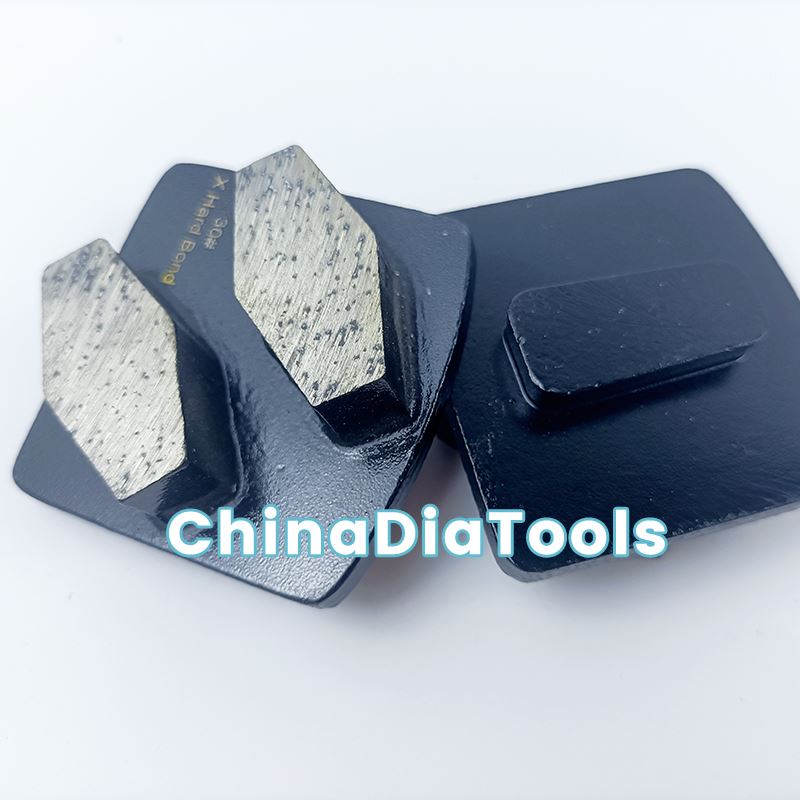
(Huicetools supply high quality floor diamond grinding shoes with Redi-lock holder)
Conclusion
The addition of manganese to diamond tools primarily leverages its ability to lower the sintering temperature of copper-based binder phases, improve wettability with skeletal materials and diamond, scavenge oxygen, and provide solid-solution strengthening. Additionally, manganese enhances matrix toughness and wear resistance, enabling the tool to better withstand impact loads.
However, because manganese oxidizes easily, may promote diamond graphitization at high temperatures, and reduces the thermal and electrical conductivity of the matrix, its usage is strictly limited-typically to no more than 5%-and is largely confined to specific systems such as W-based or WC-based formulations. Judicious use of manganese allows for an optimal balance between protecting the diamond, improving sintering quality, and enhancing the tool's overall performance.
Send Inquiry